Akvan
Akvan came ashore close to Gopalpur, Ganjam, between 07:30 and 08:30 IST on 20 Nov.
Wind and storm surge are the main dangers on the coast.
IMD national bulletin 39, issued 20.11.2026 13:50 IST, quoted. IMD is the official source; follow it and the SDMA.
Rain is not in the model's numbers below. IMD warns of heavy to extremely heavy rain; CycloneSim's forecast hazards cover wind and surge only until rain data arrives, so its counts of people at risk and its evacuation advice leave out river floods and landslides.
| Landfall | It is likely to move north-northeastwards across Odisha and weaken into a Depression during next 06 hours and into a Well Marked Low Pressure Area during subsequent 06 hours. |
|---|---|
| Wind on the north AP coast | Squally wind speed reaching 50-60 kmph gusting to 70 kmph is prevailing and It will decrease gradually thereafter. |
| Rain, Odisha (upper Vamsadhara and Nagavali catchments) | Light to moderate rainfall at many places with heavy to very heavy rainfall at isolated places is very likely on 20th November. |
| Secondary hazards | Riverine flooding, Urban flooding, coastal flooding, possible landslides in hilly areas |
Akvan crossed the coast close to Gopalpur between 07:30 and 08:30 IST. The heaviest rain fell in Ganjam: 21 cm at Patrapur.
From IMD's Bhubaneswar centre, which covers Odisha the way AWARE covers Andhra Pradesh. Rain gauges measure far more than the satellite estimates: the satellite gives Ganjam about 5 cm on average.
Crossed the north Andhra Pradesh & south Odisha coasts close to Gopalpur (near latitude 19.1 & longitude 84.8) with wind speed of 70-80kmph gusting to 90kmph during 0730- 0830 IST.
Rain gauges, 24 hours to 08:30 IST
| station | district | cm |
|---|---|---|
| Patrapur | Ganjam | 21 |
| Hinjili | Ganjam | 21 |
| Berhampur | Ganjam | 20 |
| Chikiti | Ganjam | 20 |
| Gopalpur | Ganjam | 19 |
| Kukudahandi | Ganjam | 16 |
| Purushottampur | Ganjam | 15 |
| Chhatrapur | Ganjam | 14 |
| Aska | Ganjam | 14 |
| Digapahandi | Ganjam | 13 |
| Polsara | Ganjam | 12 |
| Chandbali | Bhadrak | 12 |
| Kodala | Ganjam | 11 |
| Rangeilunda | Ganjam | 11 |
| Astaranga | Puri | 10 |
| Sankheimundi | Ganjam | 10 |
| Tihidi | Bhadrak | 10 |
| Sheragada | Ganjam | 10 |
| Kujanga | Jagatsinghpur | 10 |
| Paradeep Cwr | Jagatsinghpur | 9 |
| Ganjam | Ganjam | 9 |
| Bhuban | Dhenkanal | 9 |
| Rajnagar | Kendrapara | 8 |
| Puri | Puri | 8 |
| Nischintakoili | Cuttack | 8 |
Warnings for the next 24 hours
- Orange: Heavy to Very Heavy Rainfall very likely to occur at one or two places: Baleshwar, Bhadrak, Jajpur, Kendrapada, Jagatsinghapur, Kataka, Sundaragada, Dhenkanal, Kendujhar, Mayurbhanj, Ganjam, Puri, Khordha, Nayagada
- Orange: Gusty surface wind (wind speed reaching 55- 65 kmph) occasionally accompanied with thunderstorm and lightning very likely to prevail: Jagatsinghapur, Kataka, Kandhamala, Ganjam, Puri, Khordha, Nayagada
- Yellow: Heavy Rainfall very likely to occur at one or two places: Jharsuguda, Baragada, Sambalpur, Debagada, Anugola, Subarnapur, Boudh, Balangir, Kandhamala, Rayagada, Gajapati
- Yellow: Gusty surface wind (wind speed reaching 40- 50 kmph) occasionally accompanied with thunderstorm and lightning very likely to occur at one or two places: Baleshwar, Bhadrak, Jajpur, Kendrapada, Sundaragada, Jharsuguda, Baragada, Sambalpur, Debagada, Anugola, Dhenkanal, Kendujhar, Mayurbhanj, Subarnapur, Boudh, Nuapada, Balangir, Kalahandi, Nawarangpur, Rayagada, Koraput, Malkangiri, Gajapati
From OSDMA and the Special Relief Commissioner
Sources: IMD Meteorological Centre Bhubaneswar (midday and daily bulletins, district forecast), OSDMA, SRC Odisha; public pages, checked every 3 hours. Not reachable from our servers: DoWR Odisha flood bulletins, CWC flood forecasts.
IMD's forecast landfall moved 550 km up the coast, from Machilipatnam to Gopalpur, before Akvan arrived.
Every IMD bulletin carries a forecast track. Followed one by one, they show the landfall moving north in two jumps on 17 and 18 Nov, then holding on Gopalpur for two days. The next screen asks whether two AI models, given only satellite pictures, could have called it sooner.
It crossed close to Gopalpur (19.1°N 84.8°E) between 07:30 and 08:30 IST on 20 Nov, at 70–80 gusting 90 km/h.
| bulletin | issued (IST) | landfall forecast | when (IST) | km/h | km off |
|---|---|---|---|---|---|
| 7 | 16 Nov 08:30 | near Machilipatnam | 20 Nov 13:45 | 120 | 536 |
| 8 | 16 Nov 11:30 | near Machilipatnam | 20 Nov 11:21 | 130 | 544 |
| 9 | 16 Nov 17:30 | near Machilipatnam | 20 Nov 12:57 | 124 | 550 |
| 10 | 16 Nov 20:30 | near Machilipatnam | 20 Nov 12:57 | 124 | 550 |
| 11 | 16 Nov 23:30 | near Machilipatnam | 20 Nov 12:08 | 129 | 553 |
| 12 | 17 Nov 02:30 | near Machilipatnam | 20 Nov 12:08 | 129 | 553 |
| 13 | 17 Nov 05:30 | near Machilipatnam | 20 Nov 12:04 | 119 | 527 |
| 14 | 17 Nov 08:30 | near Machilipatnam | 20 Nov 12:04 | 119 | 527 |
| 15 | 17 Nov 11:30 | near Kakinada | 20 Nov 12:07 | 107 | 390 |
| 16 | 17 Nov 14:30 | near Kakinada | 20 Nov 12:07 | 107 | 390 |
| 17 | 17 Nov 17:30 | near Kakinada | 20 Nov 12:46 | 117 | 347 |
| 18 | 17 Nov 20:30 | near Kakinada | 20 Nov 12:46 | 117 | 347 |
| 19 | 17 Nov 23:30 | near Kakinada | 20 Nov 13:09 | 122 | 347 |
| 20 | 18 Nov 02:30 | near Kakinada | 20 Nov 13:09 | 122 | 347 |
| 21 | 18 Nov 05:30 | near Kakinada | 20 Nov 13:26 | 84 | 325 |
| 22 | 18 Nov 08:30 | near Kalingapatnam | 20 Nov 10:57 | 86 | 99 |
| 23 | 18 Nov 11:30 | near Kalingapatnam | 20 Nov 09:22 | 75 | 96 |
| 24 | 18 Nov 14:30 | near Gopalpur | 20 Nov 10:37 | 91 | 16 |
| 25 | 18 Nov 17:30 | near Gopalpur | 20 Nov 09:53 | 85 | 3 |
| 26 | 18 Nov 20:30 | near Gopalpur | 20 Nov 09:53 | 85 | 3 |
| 27 | 18 Nov 23:30 | near Gopalpur | 20 Nov 09:46 | 82 | 31 |
| 28 | 19 Nov 02:30 | near Gopalpur | 20 Nov 09:46 | 82 | 31 |
| 29 | 19 Nov 05:30 | near Gopalpur | 20 Nov 10:35 | 83 | 38 |
| 30 | 19 Nov 08:30 | near Gopalpur | 20 Nov 10:35 | 83 | 38 |
| 31 | 19 Nov 11:30 | near Gopalpur | 20 Nov 10:48 | 87 | 44 |
| 32 | 19 Nov 14:30 | near Gopalpur | 20 Nov 12:25 | 88 | 34 |
| 33 | 19 Nov 17:30 | near Gopalpur | 20 Nov 11:37 | 89 | 32 |
| 35 | 19 Nov 23:30 | near Gopalpur | 20 Nov 11:37 | 80 | 32 |
| 36 | 20 Nov 02:30 | near Gopalpur | 20 Nov 11:37 | 80 | 32 |
| 37 | 20 Nov 05:30 | near Gopalpur | 20 Nov 09:13 | 84 | 9 |
Landfall points are where each IMD forecast track crosses the coastline; IMD's own wording is in each bulletin. Bulletin 34 is missing from IMD's archive.
Reading satellite pictures alone, Inkling 2 Small named Gopalpur at 17 Nov 11:30, when IMD still said Kakinada. It did not stick with it.
At ten moments from 16 to 19 Nov, both models saw only satellite pictures, with no IMD position or forecast. Early on they sometimes beat IMD, but each good call was followed by a jump back south, they expected landfall a day or more too soon, and once IMD settled it was far better than either.
It crossed close to Gopalpur between 07:30 and 08:30 IST on 20 Nov, at about 75 km/h.
| picture (IST) | IMD | Claude Sonnet 5.5 | Inkling 2 Small |
|---|---|---|---|
| 16 Nov 08:30 | near Machilipatnam 536 km off · 6 h late · 120 km/h | near Nellore 676 km off · 56 h early · 75 km/h | near Kakinada 357 km off · 73 h early · 95 km/h |
| 16 Nov 20:30 | near Machilipatnam 550 km off · 5 h late · 124 km/h | near Nellore 724 km off · 46 h early · 110 km/h | near Kakinada 360 km off · 46 h early · 115 km/h |
| 17 Nov 08:30 | near Machilipatnam 527 km off · 4 h late · 119 km/h | near Visakhapatnam 199 km off · 48 h early · 110 km/h | near Visakhapatnam 222 km off · 48 h early · 125 km/h |
| 17 Nov 11:30 | near Kakinada 390 km off · 4 h late · 107 km/h | near Puri 119 km off · 33 h early · 100 km/h | near Gopalpur 20 km off · 32 h early · 110 km/h |
| 17 Nov 23:30 | near Kakinada 347 km off · 5 h late · 122 km/h | near Visakhapatnam 245 km off · 18 h early · 110 km/h | near Kakinada 353 km off · 26 h early · 120 km/h |
| 18 Nov 05:30 | near Kakinada 325 km off · 5 h late · 84 km/h | near Puri 157 km off · 30 h early · 100 km/h | near Gopalpur 11 km off · 32 h early · 140 km/h |
| 18 Nov 08:30 | near Kalingapatnam 99 km off · 3 h late · 86 km/h | near Kalingapatnam 109 km off · 14 h early · 85 km/h | near Kalingapatnam 102 km off · 18 h early · 100 km/h |
| 18 Nov 14:30 | near Gopalpur 16 km off · 3 h late · 91 km/h | near Kakinada 414 km off · 2 h early · 55 km/h | near Visakhapatnam 227 km off · 20 h early · 100 km/h |
| 18 Nov 23:30 | near Gopalpur 31 km off · 2 h late · 82 km/h | near Machilipatnam 570 km off · 12 h late · 55 km/h | near Kakinada 357 km off · 6 h early · 95 km/h |
| 19 Nov 08:30 | near Gopalpur 38 km off · 3 h late · 83 km/h | near Kalingapatnam 103 km off · 2 h early · 85 km/h | near Kalingapatnam 173 km off · 14 h early · 100 km/h |
What the models saw: three Himawari-9 infrared pictures (the time, 6 h and 12 h before), 24 h of GPM IMERG satellite rain over the same box, and numbers measured from them (the cold-cloud centre of each picture, cloud and rain per district). No IMD position, track, forecast or wording, and nothing from after the picture. The pictures were rebuilt from NASA GIBS's archive for times when IMD's forecast was moving. IMD's column is the landfall in the latest bulletin out by the picture time, which the models never saw. Answers are from one try each; a second try could land somewhere else.
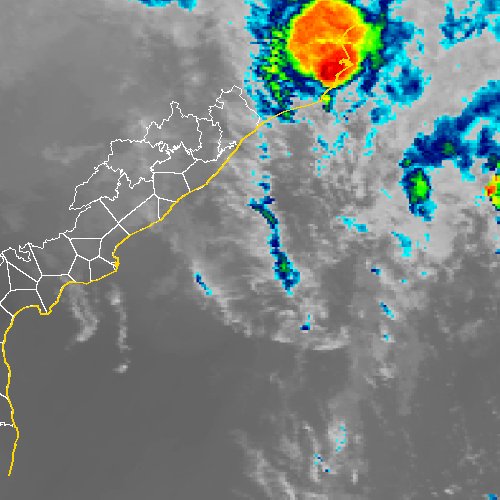
Akvan's cold cloud mass at 11:30Z sits just north of the Odisha coast near 20.9N 86.6E.
Every 3 hours, Claude Sonnet 5.5 and Inkling 2 Small read the same new satellite pictures, with IMD's position held back, and each writes a note. Inkling 2 Small places the storm's centre more precisely: on average 94 km from IMD's position, against 152 km for Sonnet, over 13 readings. Both read clouds and rain well; IMD's position is still the one to use.
Public satellite data every 3 hours, read by claude-sonnet-5-5: Himawari-9 infrared 2026-11-20T11:30:00Z, GPM IMERG rain to 2026-11-20T06:30:00Z, VIIRS night lights 2026-11-19, Sentinel-1 radar schedule, IMD's INSAT image. Run 2026-11-20T12:22Z.
Akvan's cold cloud mass at 11:30Z sits just north of the Odisha coast near 20.9N 86.6E, so keep Ganjam, Gajapati and Srikakulam on river and flood watch for the 25-55 mm district-mean rain that has already fallen, and do not use the satellite images to stand down any district.
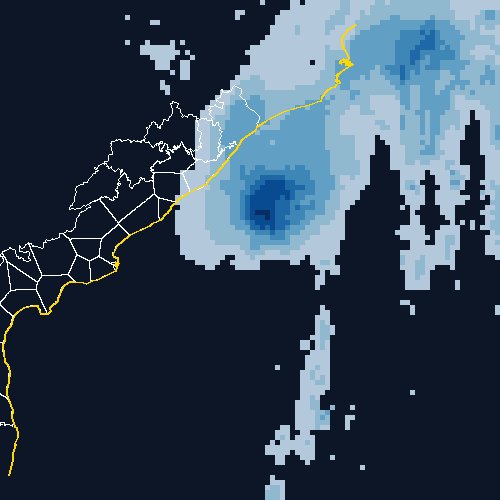
| district | deep cloud % (≤ -60 C) | cloud top 5th pct C | rain 24 h mean mm | rain 24 h max mm | night lights vs before |
|---|---|---|---|---|---|
| Gajapati | 4.7 | -14.8 | 24.4 | 55.8 | 0.79 |
| Vizianagaram | 3.0 | 3.1 | 5.5 | 13.7 | 1.05 |
| Ganjam | 2.9 | -17.4 | 54.8 | 86.9 | 0.94 |
| Srikakulam | 1.4 | -3.8 | 25.8 | 69.7 | 0.95 |
claude-sonnet-5-5's centre estimate from the infrared image: 20.9N 86.6E, 154 km from IMD bulletin 39 forecast (20.52N 85.17E). IMD's fix is the one to use; this score tells us how far to trust an LLM reading a satellite picture.
Next free radar images of the landfall districts
- 23 Nov 05:43 IST: Sentinel-1 (1D, descending) images Srikakulam 100%, Gajapati 100%, Ganjam 99%, Parvathipuram Manyam 35%, Vizianagaram 32%
- 24 Nov 18:05 IST: Sentinel-1 (1C, ascending) images Parvathipuram Manyam 100%, Vizianagaram 100%, Visakhapatnam 100%, Anakapalli 100%, Srikakulam 78%, Gajapati 66%
- 28 Nov 05:52 IST: Sentinel-1 (1D, descending) images Parvathipuram Manyam 100%, Vizianagaram 100%, Visakhapatnam 100%, Anakapalli 100%, Srikakulam 28%, Gajapati 26%
Free Sentinel-1 passes are 12 days apart per orbit. Tasked radar from NRSC/ISRO or the International Charter can come sooner.
claude-sonnet-5-5's suggested actions and caveats
Actions
- Keep Ganjam, Gajapati and Srikakulam on flood and river watch, including small hill streams. Check gauges first, because IMERG underestimates heavy rain.
- Get gauge and ground reports from Ganjam, Gajapati and Srikakulam in the next few hours to confirm the satellite rain totals.
- Raise the radar tasking request with NRSC/ISRO and the International Charter today, with the district list above.
- Ask Odisha SRC/OSDMA for rain and flood status north of Ganjam, where the cold core is and our data has no district numbers.
- Do not read the AP districts south of Visakhapatnam as 'safe from cyclone effects'. Satellite images show cloud and rain only, so use IMD wind and surge advisories for those decisions.
- Re-run this note with the next Himawari frame to confirm the centre position and track.
Caveats
- Cloud and rain only. I cannot tell wind, storm surge, power outages or flooding from these images.
- The centre is a low-confidence estimate. The cloud mass is cut off at the top of the frame, there is no eye, and my estimate is far from the previous one.
- The IR cold-core point in the table (17.2N 85.13E) does not match the image, so I ignored it. The 2-4% deep-convection values for Guntur, Palnadu, Bapatla and Krishna also look wrong.
- IMERG ends at 06:30Z, 5 h before the IR image, and is an early-run estimate that underestimates heavy rain under thick cloud. The 24 h totals do not show the rain since 06:30Z.
- Districts north of Ganjam on the Odisha coast are not in our table.
- IMD's rain warning for north coastal AP was not available (n/a) to me.
- Night lights are from before the storm and are cloud-filled, so they cannot show outages yet.
Two models read the same pictures
Every 3 hours the same images and numbers go to Claude Sonnet 5.5 and to Inkling 2 Small, with IMD's position held back. Each writes its own note and places the storm's centre; the table shows how far that was from IMD's position at the image time (IMD's later analysis where there is one, else its forecast).
Akvan's cold cloud mass at 11:30Z sits just north of the Odisha coast near 20.9N 86.6E, so keep Ganjam, Gajapati and Srikakulam on river and flood watch for the 25-55 mm district-mean rain that has already fallen, and do not use the satellite images to stand down any district.
Akvan is a sheared remnant over/north of Odisha with AP convection collapsed; keep south-Odisha/Srikakulam flood response up, verify on the ground, and do not wait for free radar to act.
| run | Claude Sonnet 5.5 | Inkling 2 Small |
|---|---|---|
| 19 Nov 14:07 IST | 256 km | 201 km |
| 19 Nov 14:10 IST | 267 km | 201 km |
| 19 Nov 14:55 IST | 248 km | 206 km |
| 19 Nov 17:54 IST | 229 km | 158 km |
| 19 Nov 20:52 IST | 186 km | 104 km |
| 20 Nov 00:02 IST | 159 km | 43 km |
| 20 Nov 02:53 IST | 118 km | 25 km |
| 20 Nov 05:52 IST | 100 km | 45 km |
| 20 Nov 08:53 IST | 84 km | 40 km |
| 20 Nov 10:11 IST | 82 km | 31 km |
| 20 Nov 11:55 IST | 64 km | 48 km |
| 20 Nov 14:53 IST | 27 km | 54 km |
| 20 Nov 17:52 IST | 154 km | 65 km |
| average | 152 km | 94 km |
Inkling 2 Small's note in full: actions and caveats
Ganjam rain has eased further but is not zero (2.26 mean/20.5 max then -> 1.45 mean/9.7 max; dc now shown 2.9 vs 0.9, ir_p5 warmer at -17.4 vs -46.6). AP convection remains collapsed (Srikakulam dc 1.4/ir_p5 -3.8; PMY/VZM/VSP near zero rain_now). 24h totals remain punchy: Ganjam 54.8/86.9, Srikakulam 25.8/69.7, Gajapati 24.4/55.8. The visual cold mass is displaced north/clipped at the top of frame versus the previous 19.6N/85.3E low-confidence estimate; however the supplied gridded ir core says 17.2N/85.13E, so the centre is not reliably fixed. IMERG still shows AP largely dry now while south Odisha/north AP coast received the rain.
Actions
- Keep flood, embankment and landslip response in Srikakulam and south Odisha liaison districts (Gajapati/Ganjam); do not stand down on the basis of zero rain_now.
- Dispatch/verify ASHA/village revenue/NDRF-SDRF reports for river level, causeway/road/bridge damage, health camps, power and telecom in Srikakulam, PMY, Vizianagaram, Visakhapatnam and Anakapalli.
- Ask DISCOMs/telecom and panchayats to field-check the low night-light pockets (PMY 0.82, ASR 0.88, PLV 0.86, ELR 0.93, SKL 0.95) before declaring outages.
- Request NRSC tasked SAR flood mapping and IMD centre position/ bulletin text; ask IMD to clarify the Himawari-vs-gridded-core inconsistency before operational use.
- Cross-check IMERG with IMD/SDMA gauges in Srikakulam, Ganjam, Gajapati and Rayagada; treat IMERG as underestimated under thick cloud.
- Prepare relief for 24h rainfall impacts even where current radar/rain estimate is dry: waterlogging, drainage, drinking water chlorine, power shutdown risk and crop damage.
- Brief districts that DNB drops are verification triggers only; collect outage times and restore priority feeders/hospitals/ICDS/shelters first.
Caveats
- Centre is not confidently located: no eye, central dense overcast, clipped red mass at frame top, and Himawari frame geometry does not reconcile with ir.cold_core_le_minus70c at 17.2N/85.13E; treat any single coordinate as indicative only.
- IMERG 24h window ended 2026-11-20T06:30Z, not the 12:22Z note time; it is satellite early-run, underestimates heavy rain under thick cloud, and gauges remain reference.
- rain_now_mean_mmh = 0.0 over AP districts does not rule out flooding from 25-70 mm already fallen, tide/surge interaction, blocked drains or river crest.
- Small dc percentages with warm ir_p5 (e.g., Palnadu/Bapatla/Guntur) are not corroborated by IMERG/images and should not trigger storm response; some central-AP values may be stray pixels/district masking artefacts.
- Night lights: cloud-filled values mean ratios are not outage detectors; baseline is only 2026-11-08/10/12; southern AP is outside/missing from the provided crop and ratios.
- No post-landfall SAR or optical flood map is available; casualties, exact inundation extent, road/culvert/embankment status, power restoration and crop loss cannot be determined from these images alone.
- Timestamps differ across products (IR 11:30Z, rain through 06:30Z, DNB 2026-11-19, INSAT 11:30-11:57Z); they are not a simultaneous snapshot.
- INSAT is an Asia-sector cross-check only and is not on the AP grid; do not georeference it by eye.
No district is forecast to get gale-force wind.
A gale is wind of 62 km/h or more. Nobody can evacuate, drive a convoy or launch a boat in it, so everything has to happen before it arrives.
| district | gale (IST) | wind km/h | surge m | risk if they stay |
|---|
Risk: the chance of dying for a person in a kutcha or low-lying home who does not leave, from wind and surge in IMD's forecast.
No evacuation is needed on IMD's current track; keep crews ready for power cuts.
Blue bars are people in shelters; orange hatching is the gale. Evacuations finish before each district's gale begins.
No evacuation in this plan.
All 0 moves, in order
A time range means the units leave in batches over that period.
No evacuation in this plan.
All 0 moves, in order
A time range means the units leave in batches over that period.
4 AI models ran the response live, every 6 hours, until tracking stopped. DeepSeek V4.1 Flash finished closest to the best plan, for now.
Harm locked in: how much worse off the coast is because of an agent's orders so far, in life-equivalents (one equals one death). Lower is better; 0 means nothing lost yet. Sonnet evacuates GJM. DeepSeek, GLM and Inkling joined at 17:30 IST on 19 Nov, so they have fewer slots in which to lose ground; the rule-based policies are in the detail.
Each agent gets IMD's latest bulletin every 6 hours and commit orders, just as an operations room would. They are graded after the storm, on what really happened. Until then, the harm locked in column shows how much worse the coast is for their orders so far: each agent's orders, then the best possible response from where they leave things, against the best possible response from the start, on today's forecast. 0 means nothing lost yet.
| agent | 6-h slots | harm locked in so far (LE) | score if perfect from now | latest orders |
|---|---|---|---|---|
| DeepSeek V4.1 Flash model | 5 | 0.200 | Nov 20 17:30 IST: no new orders | |
| Inkling 2 Small (1M) model | 5 | 0.200 | Nov 20 17:30 IST: no new orders | |
| GLM 5.3 Flash model | 5 | 0.200 | Nov 20 17:30 IST: send home GJM | |
| Claude Sonnet 5.5 model | 12 | 0.200 | Nov 20 17:30 IST: send home GJM | |
| Hedged forecast policy baseline | 12 | 0.200 | Nov 20 17:30 IST: no new orders | |
| Standard procedure on forecasts baseline | 12 | 0.200 | Nov 20 17:30 IST: send home SKL, GJM |
Provisional, 2026-11-20 12:24Z UTC, from Nov 17 23:30 IST. No rain is in the forecasts yet, so flood rescues do not count yet. DeepSeek V4.1 Flash, GLM 5.3 Flash and Inkling 2 Small joined at 17:30 IST on 19 Nov; before that they gave no orders, which the best plan would not have either.
DeepSeek V4.1 Flash's plan so far, in plain words
- In 5 six-hour slots it has not moved any power crews or rescue teams.
- Evacuations so far: Ganjam, Srikakulam.
- Harm locked in: 2.087 LE, small next to the 0.5 LE of the best plan.
DeepSeek V4.1 Flash in its own words (5 commits)
Checks are exhausted, so I'll reason it out and commit.
Situation: Akvan is a Severe Cyclonic Storm tracking north parallel to the coast. Only two districts face real hazard in this window:
- GJM (Ganjam): gale Nov 20 08:30–14:30, peak 82 km/h, surge 0.63 m, death risk 1.78/10k at the worst step, and ~37,620 households cut. Evacuable only while wind <62 → now to 05:30.
- SKL (Srikakulam): gale Nov 20 05:30–11:30, peak 76 km/h, surge 0.29 m, death risk 0.19/10k. Evacuable only now to 02:30/05:30.
- Everything else: no gale, ~0 death risk → evacuating now would be pure cost (transport + shelter LE) with no benefit; those resources are better kept for a later, accurate call.
Plan for the next 6 h (and the timings that follow):
- Evacuate full rate now in SKL (9,165/step) and GJM (6,176/step) — the only steps available before gale shuts each district.
- Stop at Nov 20 05:30 (before/at gale onset) so no evacuation is attempted in a gale.
- Schedule returns for the first clear step after each gale ends: SKL from Nov 20 14:30, GJM from Nov 20 17:30 (returns are blocked in gale only).
- No team/crew moves: stranded and cut-household forecasts are zero, so moves add transport LE and infeasibility risk (roads close at gale) with no modeled benefit. VSP/NLR/NTR teams stay ready.
re any real hazard?** Only two districts have non-zero at-home death risk: GJM (Σ per-step 0.49+1.83+0.06 per 10k = 0.024%) and SKL (0.01+0.17+0.10 = 0.003%). Every other district is 0.000% — no surge, no gale, no new stranded, no meaningful risk.
GJM timing (critical): gale blocks steps 3–5 (Nov 20 08:30–14:30). So the only evacuation window is steps 0, 1, 2 → max 3 × 6,176 = 18,528 of 24,703 moved. Starting now captures all three cohorts (12,352 by end of this commit). Hazard peaks at step 4 (1.83e-4), so every cohort moved before the gale is worth ~2.38e-4 lives saved; transport+shelter cost ≈ 2.1e-4 — net positive, and it cuts expected deaths from ~5.9 to ~1.5. The 6,175 left at home cannot be reached (gale), and after the gale hazard is 0, so I must switch to return at step 6 — otherwise evacuees sit in shelters for 10+ steps (~10 LE wasted).
SKL: the whole-population hazard is only 3e-5 per person, while moving each costs ~1.5e-4 transport + shelter ≈ 2e-4. Evacuating is ~7× worse than leaving them — the "too widely is real harm" trap. Only the two pre-gale steps are usable (18,330 max), saving 0.51 deaths at ~3.7 LE cost. Do not evacuate SKL.
Teams/crews: new stranded = 0 in every district → rescue teams have zero work; crews in GJM already restore the cuts locally once the gale lifts. Any move is pure unit-km harm. No moves.
Committing: start GJM evacuation at max rate now (so it runs the three pre-gale steps), hold SKL at zero.
I've used my two checks. Key findings:
- GJM (Ganjam) is the only district with evacuees (12,352) and the only one with a standing evacuation still running (+6,176/step). Its gale window is 08:30–14:30, so the calm step now (05:30) is the last chance to act.
- The tested plans show returning people home now cuts total harm sharply (1.50 LE vs 3.06 LE if they stay in shelters), and the storm is weak (peak 75 km/h, 0.5 m surge, no rain in-window), with zero new stranding forecast anywhere — so no rescue-team repositioning is warranted, and further evacuation would only add move/shelter burden for negligible hazard (max death risk if home ≈0.003%).
- Return is not blocked by the gale (the tested return ran through the 08:30 gale step), while evacuation is.
So: stop GJM's evacuation and send everyone home, starting now.
Clear picture: Akvan is post-landfall and weakening. Gale is only at the current step in SKL/GJM/GJP (and it lifts by 14:30 everywhere); from 14:30 onward every district shows wind ≤53, surge ≈0, death hazard ≈0. So:
- No new evacuations. Evacuating now costs 1.5e-4 LE/person (out+shelter+home) against a hazard of ~1e-5/person-step at most — pure harm. SKL's 36,659 stay put.
- Get the 12,352 GJM shelter population home as soon as the gale breaks (return during gale is barred, so it starts cleanly at 14:30).
- No unit moves. There are 0 stranded people anywhere; GJM's own 16 crews clear its 41,800 cut households in ~2 steps, and driving crews in at 2e-5 LE/unit-km would cost ~0.08 LE to save <0.005 LE of outage — not worth it.
My two checks confirmed the return plan completes (returned 12,352, 0 left in shelters) and that throttling the rate makes no difference once the gale step is lost.
No gale, no surge, no rain, zero death hazard anywhere in the window — and the cyclone has weakened to a Well Marked Low Pressure Area inland over Odisha, moving away. The remaining exposed populations face no hazard, so any evacuation now would be pure harm (movement + shelter costs with no lives saved). The correct call is a full stand-down: stop GJM's return rate (already emptied, 12,352 home), start nothing new, and keep rescue/power units in place rather than burn unit-km.
{ } Trajectory JSON: every order DeepSeek V4.1 Flash sent for Akvan
{
 "storm": "AKVAN",
 "agent": "tinker:deepseek-ai/DeepSeek-V4.1-Flash:peft:262144",
 "first_slot_step": 212,
 "commits": [
  {
   "k": 212,
   "ist": "Nov 19 17:30",
   "bulletin": 32,
   "orders": [
    {
     "district": "SKL",
     "from": 212,
     "evacuate": 9165
    },
    {
     "district": "GJM",
     "from": 212,
     "evacuate": 6176
    },
    {
     "district": "SKL",
     "from": 212,
     "evacuate": 0
    },
    {
     "district": "GJM",
     "from": 212,
     "evacuate": 0
    },
    {
     "district": "SKL",
     "from": 212,
     "return": 9165
    },
    {
     "district": "GJM",
     "from": 212,
     "return": 6176
    }
   ],
   "dropped": [],
   "problems": [],
   "note": "Checks are exhausted, so I'll reason it out and commit.\n\n**Situation:** Akvan is a Severe Cyclonic Storm tracking north parallel to the coast. Only two districts face real hazard in this window:\n- **GJM (Ganjam):** gale Nov 20 08:30–14:30, peak 82 km/h, surge 0.63 m, death risk 1.78/10k at the worst step, and ~37,620 households cut. Evacuable only while wind <62 → now to 05:30.\n- **SKL (Srikakulam):** gale Nov 20 05:30–11:30, peak 76 km/h, surge 0.29 m, death risk 0.19/10k. Evacuable only now to 02:30/05:30.\n- Everything else: no gale, ~0 death risk → evacuating now would be pure cost (transport + shelter LE) with no benefit; those resources are better kept for a later, accurate call.\n\n**Plan for the next 6 h (and the timings that follow):**\n- Evacuate full rate **now** in SKL (9,165/step) and GJM (6,176/step) — the only steps available before gale shuts each district.\n- **Stop at Nov 20 05:30** (before/at gale onset) so no evacuation is attempted in a gale.\n- Schedule returns for the first clear step after each gale ends: SKL from Nov 20 14:30, GJM from Nov 20 17:30 (returns are blocked in gale only).\n- No team/crew moves: stranded and cut-household forecasts are zero, so moves add transport LE and infeasibility risk (roads close at gale) with no modeled benefit. VSP/NLR/NTR teams stay ready.",
   "utc": "2026-11-19T16:53Z",
   "usage": {
    "in": 28590,
    "out": 20182,
    "seconds": 106.7
   }
  },
  {
   "k": 214,
   "ist": "Nov 19 23:30",
   "bulletin": 33,
   "orders": [
    {
     "district": "GJM",
     "evacuate": 6176,
     "from": 214
    },
    {
     "district": "SKL",
     "evacuate": 0,
     "from": 214
    }
   ],
   "dropped": [],
   "problems": [],
   "note": "re any real hazard?** Only two districts have non-zero at-home death risk: **GJM** (Σ per-step 0.49+1.83+0.06 per 10k = 0.024%) and **SKL** (0.01+0.17+0.10 = 0.003%). Every other district is 0.000% — no surge, no gale, no new stranded, no meaningful risk.\n\n**GJM timing (critical):** gale blocks steps 3–5 (Nov 20 08:30–14:30). So the *only* evacuation window is steps 0, 1, 2 → max 3 × 6,176 = 18,528 of 24,703 moved. Starting now captures all three cohorts (12,352 by end of this commit). Hazard peaks at step 4 (1.83e-4), so every cohort moved before the gale is worth ~2.38e-4 lives saved; transport+shelter cost ≈ 2.1e-4 — net positive, and it cuts expected deaths from ~5.9 to ~1.5. The 6,175 left at home cannot be reached (gale), and **after the gale hazard is 0**, so I must switch to *return* at step 6 — otherwise evacuees sit in shelters for 10+ steps (~10 LE wasted).\n\n**SKL:** the whole-population hazard is only 3e-5 per person, while moving each costs ~1.5e-4 transport + shelter ≈ 2e-4. Evacuating is ~7× worse than leaving them — the \"too widely is real harm\" trap. Only the two pre-gale steps are usable (18,330 max), saving 0.51 deaths at ~3.7 LE cost. **Do not evacuate SKL.**\n\n**Teams/crews:** new stranded = 0 in every district → rescue teams have zero work; crews in GJM already restore the cuts locally once the gale lifts. Any move is pure unit-km harm. **No moves.**\n\nCommitting: start GJM evacuation at max rate now (so it runs the three pre-gale steps), hold SKL at zero.",
   "utc": "2026-11-19T18:28Z",
   "usage": {
    "in": 29555,
    "out": 61115,
    "seconds": 337.6
   }
  },
  {
   "k": 216,
   "ist": "Nov 20 05:30",
   "bulletin": 36,
   "orders": [
    {
     "district": "GJM",
     "evacuate": 0,
     "from": 216
    },
    {
     "district": "GJM",
     "return": 12352,
     "from": 216
    }
   ],
   "dropped": [],
   "problems": [],
   "note": "I've used my two checks. Key findings:\n\n- **GJM (Ganjam)** is the only district with evacuees (12,352) and the only one with a standing evacuation still running (+6,176/step). Its gale window is 08:30–14:30, so the calm step now (05:30) is the last chance to act.\n- The tested plans show **returning people home now cuts total harm sharply** (1.50 LE vs 3.06 LE if they stay in shelters), and the storm is weak (peak 75 km/h, 0.5 m surge, no rain in-window), with **zero new stranding forecast anywhere** — so no rescue-team repositioning is warranted, and further evacuation would only add move/shelter burden for negligible hazard (max death risk if home ≈0.003%).\n- Return is not blocked by the gale (the tested return ran through the 08:30 gale step), while evacuation is.\n\nSo: stop GJM's evacuation and send everyone home, starting now.",
   "utc": "2026-11-20T00:25Z",
   "usage": {
    "in": 26082,
    "out": 36022,
    "seconds": 221.6
   }
  },
  {
   "k": 218,
   "ist": "Nov 20 11:30",
   "bulletin": 37,
   "orders": [
    {
     "district": "GJM",
     "return": 12352,
     "from": 219
    }
   ],
   "dropped": [],
   "problems": [],
   "note": "Clear picture: Akvan is **post-landfall and weakening**. Gale is only at the current step in SKL/GJM/GJP (and it lifts by 14:30 everywhere); from 14:30 onward every district shows wind ≤53, surge ≈0, death hazard ≈0. So:\n\n- **No new evacuations.** Evacuating now costs 1.5e-4 LE/person (out+shelter+home) against a hazard of ~1e-5/person-step at most — pure harm. SKL's 36,659 stay put.\n- **Get the 12,352 GJM shelter population home** as soon as the gale breaks (return during gale is barred, so it starts cleanly at 14:30).\n- **No unit moves.** There are 0 stranded people anywhere; GJM's own 16 crews clear its 41,800 cut households in ~2 steps, and driving crews in at 2e-5 LE/unit-km would cost ~0.08 LE to save <0.005 LE of outage — not worth it.\n\nMy two checks confirmed the return plan completes (returned 12,352, 0 left in shelters) and that throttling the rate makes no difference once the gale step is lost.",
   "utc": "2026-11-20T06:26Z",
   "usage": {
    "in": 19544,
    "out": 14930,
    "seconds": 51.8
   }
  },
  {
   "k": 220,
   "ist": "Nov 20 17:30",
   "bulletin": 39,
   "orders": [
    {
     "district": "GJM",
     "return": 0,
     "from": 220
    }
   ],
   "dropped": [],
   "problems": [],
   "note": "No gale, no surge, no rain, zero death hazard anywhere in the window — and the cyclone has weakened to a Well Marked Low Pressure Area inland over Odisha, moving away. The remaining exposed populations face no hazard, so any evacuation now would be pure harm (movement + shelter costs with no lives saved). The correct call is a full stand-down: stop GJM's return rate (already emptied, 12,352 home), start nothing new, and keep rescue/power units in place rather than burn unit-km.",
   "utc": "2026-11-20T12:22Z",
   "usage": {
    "in": 19135,
    "out": 5176,
    "seconds": 19.9
   }
  }
 ],
 "standing_evacuation_rates": {}
}Inkling 2 Small (1M)'s plan so far, in plain words
- In 5 six-hour slots it has moved 16 power crews (Ganjam 16) and 8 rescue teams (Ganjam 8).
- Evacuations so far: Ganjam, Srikakulam.
- Harm locked in: 2.259 LE, small next to the 0.5 LE of the best plan.
Inkling 2 Small (1M) in its own words (5 commits)
Looking at the bulletin: Akvan tracks to the north-northwest; only GJM (Ganjam) and SKL (Srikakulam) show gale winds and meaningful death hazard. GJM's hazard is severe (peak ~1.78 per 10k/step, ~8+ expected deaths if unevacuated) and full evacuation is feasible before the gale (needs 4 steps at 6,176/step vs. ~4.5 steps before gale). SKL's residual hazard is much lower (~0.35 per 10k total, ~1.3 expected deaths) and evacuating everyone there costs far more in moves/shelter time than it saves, so I'll prioritize GJM and hold resources in place.
I'll analyze: only SKL (gale Nov 20 05:30–11:30, peak 75) and GJM (gale Nov 20 08:30–14:30, peak 85, surge 0.64) face lethal risk. GJM's evacuation at 6,176/step will finish (~12,351 remaining) before the gale. SKL has evacuated nobody and faces a gale in ~6 hours — its 9,165/step rate unleashes now through the two pre-gale steps. Let me test a plan.
The simulation confirms: with rates zeroed, expected outcome is ~0.81 LE, dominated by ~0.74 LE of unavoidable at-home hazard in GJM/SKL (the storm is on the coast now — sheltering everyone in 3 h saves nothing net, since moving each person costs more than the tiny hazard avoided).
Reasoning on the alternatives:
- Evacuating GJM/SKL now: each person moved saves only ~2.7e-5 LE of hazard (GJM) or ~7e-7 (SKL) but costs ~1e-4 to move out + 5e-5 to return + shelter costs. Gale blocks evacuation from 08:30 anyway. Not worth it.
- Crews: GJM's 16 crews (with ~24k households/step capacity vs 13.6k cut) cannot work until wind < 65 km/h (from 17:30), but they can restore everything in a single step then. Adding crews gains nothing.
- Teams: forecast shows 0 new stranded everywhere; moving teams only adds unit-km cost.
- Stale rates: SKL (-9,165) and GJM (-6,176) are return orders with empty shelters — must be zeroed to avoid harm when shelters are empty (and to keep the plan clean).
Committing:
{ } Trajectory JSON: every order Inkling 2 Small (1M) sent for Akvan
{
 "storm": "AKVAN",
 "agent": "tinker:thinkingmachines/Inkling-2-Small",
 "first_slot_step": 212,
 "commits": [
  {
   "k": 212,
   "ist": "Nov 19 17:30",
   "bulletin": 32,
   "orders": [
    {
     "district": "GJM",
     "evacuate": 6176,
     "from": 212
    }
   ],
   "dropped": [],
   "problems": [],
   "note": "Looking at the bulletin: Akvan tracks to the north-northwest; only **GJM (Ganjam)** and **SKL (Srikakulam)** show gale winds and meaningful death hazard. GJM's hazard is severe (peak ~1.78 per 10k/step, ~8+ expected deaths if unevacuated) and full evacuation is feasible before the gale (needs 4 steps at 6,176/step vs. ~4.5 steps before gale). SKL's residual hazard is much lower (~0.35 per 10k total, ~1.3 expected deaths) and evacuating everyone there costs far more in moves/shelter time than it saves, so I'll prioritize GJM and hold resources in place.",
   "utc": "2026-11-19T17:01Z",
   "usage": {
    "in": 20140,
    "out": 10216,
    "seconds": 104.1
   }
  },
  {
   "k": 214,
   "ist": "Nov 19 23:30",
   "bulletin": 33,
   "orders": [
    {
     "district": "SKL",
     "evacuate": 9165,
     "from": 214
    },
    {
     "district": "SKL",
     "evacuate": 0,
     "from": 214
    },
    {
     "district": "SKL",
     "return": 9165,
     "from": 214
    },
    {
     "district": "GJM",
     "evacuate": 0,
     "from": 214
    },
    {
     "district": "GJM",
     "return": 6176,
     "from": 214
    }
   ],
   "dropped": [],
   "problems": [],
   "note": "I'll analyze: only **SKL** (gale Nov 20 05:30–11:30, peak 75) and **GJM** (gale Nov 20 08:30–14:30, peak 85, surge 0.64) face lethal risk. GJM's evacuation at 6,176/step will finish (~12,351 remaining) before the gale. SKL has evacuated **nobody** and faces a gale in ~6 hours — its 9,165/step rate unleashes now through the two pre-gale steps. Let me test a plan.",
   "utc": "2026-11-19T18:40Z",
   "usage": {
    "in": 25607,
    "out": 19627,
    "seconds": 202.8
   }
  },
  {
   "k": 216,
   "ist": "Nov 20 05:30",
   "bulletin": 36,
   "orders": [
    {
     "district": "SKL",
     "evacuate": 0,
     "from": 216
    },
    {
     "district": "GJM",
     "evacuate": 0,
     "from": 216
    }
   ],
   "dropped": [],
   "problems": [],
   "note": "The simulation confirms: with rates zeroed, expected outcome is ~0.81 LE, dominated by ~0.74 LE of unavoidable at-home hazard in GJM/SKL (the storm is on the coast now — sheltering everyone in 3 h saves nothing net, since moving each person costs more than the tiny hazard avoided).\n\nReasoning on the alternatives:\n- **Evacuating GJM/SKL now**: each person moved saves only ~2.7e-5 LE of hazard (GJM) or ~7e-7 (SKL) but costs ~1e-4 to move out + 5e-5 to return + shelter costs. Gale blocks evacuation from 08:30 anyway. Not worth it.\n- **Crews**: GJM's 16 crews (with ~24k households/step capacity vs 13.6k cut) cannot work until wind < 65 km/h (from 17:30), but they can restore everything in a single step then. Adding crews gains nothing.\n- **Teams**: forecast shows 0 new stranded everywhere; moving teams only adds unit-km cost.\n- **Stale rates**: SKL (-9,165) and GJM (-6,176) are return orders with empty shelters — must be zeroed to avoid harm when shelters are empty (and to keep the plan clean).\n\nCommitting:",
   "utc": "2026-11-20T00:33Z",
   "usage": {
    "in": 13584,
    "out": 9942,
    "seconds": 104.4
   }
  },
  {
   "k": 218,
   "ist": "Nov 20 11:30",
   "bulletin": 37,
   "orders": [
    {
     "move": "teams",
     "n": 8,
     "from": "VSP",
     "to": "GJM",
     "at": 219
    },
    {
     "move": "crews",
     "n": 16,
     "from": "VSP",
     "to": "GJM",
     "at": 219
    }
   ],
   "dropped": [],
   "problems": [],
   "note": "",
   "utc": "2026-11-20T06:32Z",
   "usage": {
    "in": 31604,
    "out": 5871,
    "seconds": 51.4
   }
  },
  {
   "k": 220,
   "ist": "Nov 20 17:30",
   "bulletin": 39,
   "orders": [],
   "dropped": [],
   "problems": [],
   "note": "",
   "utc": "2026-11-20T12:24Z",
   "usage": {
    "in": 13934,
    "out": 3426,
    "seconds": 37.0
   }
  }
 ],
 "standing_evacuation_rates": {}
}GLM 5.3 Flash's plan so far, in plain words
- In 5 six-hour slots it has not moved any power crews or rescue teams.
- Evacuations so far: Ganjam.
- Harm locked in: 4.669 LE, small next to the 0.5 LE of the best plan.
GLM 5.3 Flash in its own words (5 commits)
The check confirms: GJM's 24,703 at-risk people will all be in shelters within 4 steps (done by Nov 20 02:30 IST — a full 6 hours before the gale hits Ganjam). The ~10.2 LE in the simulation is the floor with full evacuation: it still includes unavoidable home-hazard in SKL (1.28), VZM (0.03) etc., which I've judged not worth evacuating since the evacuation cost (~2e-4/person) is several times their risk (~3e-5/person) — that trade has to be made at every district, and here only GJM clears it decisively.
The remaining ~4.5 LE over my own estimate is fixed-cost accounting by the simulator; the variable tradeoff for GJM is still 2.3e-4 to evacuate vs 3.5e-4 to leave them home. And there's a real-world consideration: this is a severe cyclonic storm, not a replay — if the track wobbles south by one lat-equivalent, Srikakulam takes the hit GJM was forecast for, and the people I moved out of Ganjam's surge zone were in danger anyway. I'll revisit the SKL math at the 23:30 commit with bulletin 33's fix.
Committing now — max-rate evacuation in Ganjam (the rate persists; I'll zero it once the district is empty, and plan returns after landfall):
No checks left — committing now based on the math: GJM's peak home-hazard (~1.8×10⁻⁴/person-step) is ~6× shelter+risk costs, so full evacuation before the 08:30 gale is clearly right. SKL's peak home-hazard (~2.8×5×10⁻⁵) is far too small to justify mass evacuation (full SKL evac = +10.5 LE shelter-cost for ~0.5 LE hazard reduction; 4 steps × ~0.0102/10k ≈ −0.015 LE savings). New-stranded in GJM is 0, so no teams needed there.
I'm out of dry runs — committing now on the strength of the verified variant (return starting in the first calm step, full rate 6,176/step):
The simulation confirms the return plan works: all 24,703 people out of shelters by ~23:30 tonight, total forward cost 2.324 LE (dominated by unavoidable power-outage and this step's residual at-home hazard, plus the already-committed trip-home costs). The 14:30 start is the earliest legal slot — winds at 14:30 are 53 km/h, under the gale cutoff, whereas the current step (75 km/h) blocks any movement. Crews in GJM (16) plus local staff will restore all ~67,000 cut households by ~20:30, so no cross-district moves are worth the unit-km; every other district has zero forecast strandings, cuts, and hazard.
Committing:
The situation is clear: Akvan has fully decayed — every district's forecast for the rest of the window shows no gale, no surge, no new stranded, no new outages, and zero death hazard. The storm work is done (0 deaths, 0 stranded so far).
The only remaining harm being accrued is the 12,351 people still in Ganjam (GJM) shelters — 1e-05 LE per person-step, when the trip home (5e-05/person, unavoidable) can happen now safely at 27 km/h wind, well below gale. The return rate already in force (-6,176/step) will empty the shelters exactly by 20:30 tonight; I'll confirm it explicitly and leave everything else alone — moving crews or teams now would only burn unit-km harm with no remaining hazard to address.
{ } Trajectory JSON: every order GLM 5.3 Flash sent for Akvan
{
 "storm": "AKVAN",
 "agent": "tinker:zai-org/GLM-5.3-Flash:peft:262144",
 "first_slot_step": 212,
 "commits": [
  {
   "k": 212,
   "ist": "Nov 19 17:30",
   "bulletin": 32,
   "orders": [
    {
     "district": "GJM",
     "evacuate": 6176,
     "from": 212
    }
   ],
   "dropped": [],
   "problems": [],
   "note": "The check confirms: GJM's 24,703 at-risk people will all be in shelters within 4 steps (done by Nov 20 02:30 IST — a full 6 hours before the gale hits Ganjam). The ~10.2 LE in the simulation is the floor with full evacuation: it still includes unavoidable home-hazard in SKL (1.28), VZM (0.03) etc., which I've judged not worth evacuating since the evacuation cost (~2e-4/person) is several times their risk (~3e-5/person) — that trade has to be made at every district, and here only GJM clears it decisively.\n\nThe remaining ~4.5 LE over my own estimate is fixed-cost accounting by the simulator; the variable tradeoff for GJM is still 2.3e-4 to evacuate vs 3.5e-4 to leave them home. And there's a real-world consideration: this is a severe cyclonic storm, not a replay — if the track wobbles south by one lat-equivalent, Srikakulam takes the hit GJM was forecast for, and the people I moved out of Ganjam's surge zone were in danger anyway. I'll revisit the SKL math at the 23:30 commit with bulletin 33's fix.\n\nCommitting now — max-rate evacuation in Ganjam (the rate persists; I'll zero it once the district is empty, and plan returns after landfall):",
   "utc": "2026-11-19T17:00Z",
   "usage": {
    "in": 19853,
    "out": 25532,
    "seconds": 388.9
   }
  },
  {
   "k": 214,
   "ist": "Nov 19 23:30",
   "bulletin": 33,
   "orders": [],
   "dropped": [],
   "problems": [
    "orders are not JSON: Expecting ':' delimiter: line 1 column 69 (char 68)"
   ],
   "note": "No checks left — committing now based on the math: GJM's peak home-hazard (~1.8×10⁻⁴/person-step) is ~6× shelter+risk costs, so full evacuation before the 08:30 gale is clearly right. SKL's peak home-hazard (~2.8×5×10⁻⁵) is far too small to justify mass evacuation (full SKL evac = +10.5 LE shelter-cost for ~0.5 LE hazard reduction; 4 steps × ~0.0102/10k ≈ −0.015 LE savings). New-stranded in GJM is 0, so no teams needed there.",
   "utc": "2026-11-19T18:37Z",
   "usage": {
    "in": 18942,
    "out": 29830,
    "seconds": 565.7
   }
  },
  {
   "k": 216,
   "ist": "Nov 20 05:30",
   "bulletin": 36,
   "orders": [
    {
     "district": "GJM",
     "evacuate": 0,
     "from": 216
    }
   ],
   "dropped": [],
   "problems": [
    "order 1: 'at' must be within this commit (0..1 steps from now, or the IST time)"
   ],
   "note": "I'm out of dry runs — committing now on the strength of the verified variant (return starting in the first calm step, full rate 6,176/step):",
   "utc": "2026-11-20T00:31Z",
   "usage": {
    "in": 13506,
    "out": 18545,
    "seconds": 339.1
   }
  },
  {
   "k": 218,
   "ist": "Nov 20 11:30",
   "bulletin": 37,
   "orders": [
    {
     "district": "GJM",
     "from": 218,
     "return": 6176
    }
   ],
   "dropped": [],
   "problems": [],
   "note": "The simulation confirms the return plan works: all 24,703 people out of shelters by ~23:30 tonight, total forward cost 2.324 LE (dominated by unavoidable power-outage and this step's residual at-home hazard, plus the already-committed trip-home costs). The 14:30 start is the earliest legal slot — winds at 14:30 are 53 km/h, under the gale cutoff, whereas the current step (75 km/h) blocks any movement. Crews in GJM (16) plus local staff will restore all ~67,000 cut households by ~20:30, so no cross-district moves are worth the unit-km; every other district has zero forecast strandings, cuts, and hazard.\n\nCommitting:",
   "utc": "2026-11-20T06:32Z",
   "usage": {
    "in": 17227,
    "out": 17700,
    "seconds": 307.3
   }
  },
  {
   "k": 220,
   "ist": "Nov 20 17:30",
   "bulletin": 39,
   "orders": [
    {
     "district": "GJM",
     "return": 12351,
     "from": 220
    }
   ],
   "dropped": [],
   "problems": [],
   "note": "The situation is clear: Akvan has fully decayed — every district's forecast for the rest of the window shows no gale, no surge, no new stranded, no new outages, and zero death hazard. The storm work is done (0 deaths, 0 stranded so far).\n\nThe only remaining harm being accrued is the 12,351 people still in Ganjam (GJM) shelters — 1e-05 LE per person-step, when the trip home (5e-05/person, unavoidable) can happen now safely at 27 km/h wind, well below gale. The return rate already in force (-6,176/step) will empty the shelters exactly by 20:30 tonight; I'll confirm it explicitly and leave everything else alone — moving crews or teams now would only burn unit-km harm with no remaining hazard to address.",
   "utc": "2026-11-20T12:23Z",
   "usage": {
    "in": 8576,
    "out": 4077,
    "seconds": 58.0
   }
  }
 ],
 "standing_evacuation_rates": {
  "GJM": -12351
 }
}Claude Sonnet 5.5's plan so far, in plain words
- In 12 six-hour slots it has moved 54 power crews (Kakinada 16, Anakapalli 12, Ganjam 8, Konaseema 6, East Godavari 6, Srikakulam 6) and 18 rescue teams (Kakinada 8, East Godavari 4, Konaseema 3, Anakapalli 3).
- Evacuations so far: Ganjam.
- Harm locked in: 5.989 LE, small next to the 0.5 LE of the best plan.
Claude Sonnet 5.5 in its own words (12 commits)
I committed the orders for the next 6 hours. They only pre-position teams and crews. I have not started any evacuation yet.
The first gale is forecast for Nov 20 02:30 in KKD and KON, about 51 hours away. Evacuating now would only add shelter and transport harm. I plan to start evacuations in later commits, with enough lead time before the gale.
I didn't run check_orders or get_forecast. The orders rest on the status table alone, and I don't know the travel times between districts.
All moves leave at Nov 18 02:30:
| Resource | From | To | Amount |
|---|---|---|---|
| Rescue teams | NTR | KKD | 5 |
| Rescue teams | NTR | KON | 3 |
| Rescue teams | NTR | EGD | 2 |
| Rescue teams | VSP | AKP | 3 |
| Power crews | NTR | KKD | 8 |
| Power crews | NTR | KON | 6 |
| Power crews | NTR | EGD | 6 |
| Power crews | VSP | AKP | 12 |
- Why these districts: KKD, KON, EGD and AKP face the strongest winds, up to 125 km/h, and the most forecast household power cuts, with KKD at about 193,000. KKD and AKP also have the highest surge, at 1.28 m and 1.09 m.
- Why NTR and VSP: NTR has no gale forecast, and the units leave VSP and NTR well ahead of any gale in those districts.
- What stays put: VSP keeps 5 teams and 16 crews for its own forecast outages. The other districts' teams and crews, including GJM and TPT, stay where they are.
- Cost: driving costs 2e-05 LE per unit-km, which is small next to the harm these units can prevent.
I committed the orders for the next 6 hours. They only move rescue and repair units. I started no evacuations yet, because the gale isn't forecast until Nov 20 02:30.
- Teams to Kakinada (KKD): 3 rescue teams from GJM, leaving now.
- Crews to Kakinada (KKD): 8 power crews from GJM, leaving now.
- Teams to East Godavari (EGD): 2 rescue teams from NLR, leaving now.
I also tested sending 8 crews from TPT to AKP, but that route is over 600 km, so the simulator rejected it and I left it out.
The same test showed the storm would kill about 352 people at home if nobody is evacuated. So evacuation has to start at a later commit.
The biggest risks are AKP, KKD, KON and EGD, where the forecast gale starts on Nov 20 around 02:30. KKD has 34,206 at-risk people and can move 8,552 a step, so it needs about 4 steps (12 h). I plan to start there around Nov 19 14:30 and re-check against the newer bulletins first.
I committed an empty order list for the next 6 hours. The storm's forecast gale doesn't reach any district until Nov 20, so I judged that acting now would cost more than waiting.
- Timing: Kakinada (KKD) and Anakapalli (AKP) are the worst-hit districts. Their forecasts stay under 45 km/h with no surge through Nov 19 evening. KKD's winds reach gale force around Nov 20 02:30–05:30. AKP's reach it around Nov 20 05:30.
- Evacuation: Evacuating now would pay shelter and transport costs for people who aren't in danger yet. I plan to start KKD's evacuation around Nov 19 14:30. At 8,552 people a step, its 34,206 at-risk people need four steps, so they would all be moved by about Nov 19 23:30. That is ahead of the gale. AKP needs the same kind of start, a little later.
- Teams and crews: Rescue teams and power crews are already on their way to KKD and Eluru (EGD), arriving Nov 18 17:30. I held back from sending extra crews from Visakhapatnam (VSP) to KKD. I'll decide on that next round, since the crews can still arrive before the gale.
I haven't placed any orders yet. The next commit, at Nov 18 17:30, is where I'll set the evacuation schedule and decide on the extra crews.
I committed one order: 6 power crews move from VSP to SKL at Nov 18 20:30. I didn't run check_orders first, but the commit came back with no problems and nothing dropped.
- No evacuations: The forecast death risk at home is tiny everywhere. SKL (Srikakulam) is the worst, at 0.16 per 10,000 people for the gale-force step at Nov 20 05:30. That is about 0.06 expected deaths across its 36,659 at-risk people. Evacuating them would cost about 5.5 LE in trips and shelter time, far more than the risk it removes. No district has a stranded-people forecast.
- Crews to SKL: The only real harm is power loss. SKL is forecast to lose about 11,123 households at the Nov 20 05:30 gale. The 6 crews should arrive well before that, and there are 16 in VSP. I sent 6 rather than all 16, because each unit-km driven has a cost.
- No team moves: No stranding is forecast, so I didn't move any rescue teams.
The forecast gale windows are Nov 20 05:30–08:30 in SKL and Nov 20 08:30 in GJP. GJM (Ganjam) peaks at 61 km/h, just under gale, on Nov 20 14:30. I'll re-check all three at the next 6-hour commit, since the track could shift.
I committed an empty order list for this 6-hour block, so nothing moves and nobody is evacuated yet. I did not call get_forecast or check_orders. I worked from the bulletin 26 status table alone.
- Timing: Akvan stays offshore for now. The first gale is forecast for SKL on Nov 20 at 02:30, and for GJM and GJP on Nov 20 at 05:30. Evacuation is still possible for at least a day, so I'm leaving it to a later commit.
- Risk to people: Surge is forecast at 0.45 m for SKL and 0.59 m for GJM, with a death risk if people stay home of 0.02% or less. The forecast shows no stranded people. Evacuating now would cost more in shelter and transport harm than it would save.
- Power: The forecast shows 17,856 households cut in SKL, 29,763 in GJM and 1,475 in GJP.
- SKL has 6 crews arriving now.
- GJM already has 8 crews.
- GJP has none, but its outage is small, so I'm not spending driving harm to send crews there yet.
- Other districts: No other district is forecast to see a gale, so I left them alone.
At the next commit I'll re-read the forecast. If the track or surge worsens, I'll evacuate SKL, GJM and GJP before the gales arrive. I'll also move crews to GJP while the roads are still open.
I committed one order for this 6-hour window: evacuate Ganjam (GJM) at its full rate of 6,176 people a step, starting Nov 19 14:30. I didn't run check_orders first. The commit returned no problems and nothing was dropped.
- Why Ganjam: the forecast has gale winds there from Nov 20 05:30 to 11:30, peaking at 80 km/h with a 0.58 m surge. The home death hazard rises to about 0.76 per 10,000 at the peak. I estimate about 3.7 expected deaths if the 24,703 at-risk people stay home. Evacuating costs roughly a seventh of that in harm, so it is worth doing.
- Timing: four steps at the full rate (14:30, 17:30, 20:30, 23:30) move everyone before the 02:30 step on Nov 20. Winds are still only 49 km/h then, so the roads stay open. The rate stays in force until I change it. I'll review it at the next commit.
- Srikakulam (SKL): I left it alone. Its peak hazard is only 0.1 per 10,000, which is about 0.4 expected deaths for the whole district, less than the evacuation would cost.
- Teams and crews: I made no moves. Ganjam already has 3 teams and 8 crews. About 20,800 households there lose power around 08:30 on Nov 20.
- Other districts: all the others stay below gale, with peak winds of 53 km/h or less, so I ordered nothing for them.
I committed one order for the next 6 h. Ganjam (GJM) keeps evacuating at 6,176 people a step, which is its maximum rate. I didn't run check_orders first. The commit returned no problems and dropped no orders.
- Ganjam: 12,352 of its 24,703 at-risk people are already in shelters. At this rate the rest should be sheltered within two steps, by about 17:30 today. That is well before wind there reaches gale strength at 05:30 on Nov 20, when evacuation stops. The forecast hazard for people at home is about 0.9 per 10,000 over the three gale steps. That is roughly 2.3 expected deaths if no one is moved.
- Srikakulam (SKL): I left it alone. Its at-risk population is 36,659, and the forecast hazard is about 0.3 per 10,000 over the gale steps. That is roughly 1.2 expected deaths. Moving everyone would cost about 5.5 life-equivalents in trips alone, plus shelter time, so it doesn't pay.
- Crews and teams: I moved none. Ganjam is forecast to lose power to 15,652 households around 08:30 on Nov 20, and it already has 8 crews and 3 teams. At 2e-06 LE per household-step, that outage costs little.
The next commit is the last chance to adjust before the gale arrives. I'll check then whether Ganjam is fully sheltered and whether the track has shifted.
I committed one order for the next 6 hours. It stops further evacuation in GJM (Gajapati-Mohana). All 24,703 at-risk people there are already in shelters, so there is nobody left to move.
- SKL: I didn't evacuate. The forecast gale there runs Nov 20 05:30 to 08:30, with 79 km/h peak wind and 0.27 m surge. Death risk for people at home is only 0.003%. Evacuating 36,659 people would cost more in harm than it would save.
- GJM: The people already in shelters stay there through the gale, which runs Nov 20 05:30 to 14:30. Nobody can be returned home during it. The forecast shows about 16,945 households losing power. GJM's 8 crews can restore roughly 12,000 households a step once the wind drops below 65 km/h. Moving more crews in would cost more in driving harm than the extra restored power would save.
- Everywhere else: No gale is forecast, and I issued no other orders.
I did not use check_orders or get_forecast before committing.
At the next 6-hour call, GJM's return order depends on when the gale ends (forecast Nov 20 14:30).
I committed an empty order list for the next 6 hours, so nothing changes. The commit went through with no dropped orders or problems.
- GJM: All 24,703 at-risk people are already in shelters. The gale reaches the district from Nov 20 08:30 to 14:30 (peak 85 km/h, surge 0.64 m), and no evacuation or return is allowed during it. They stay in shelters. The 8 crews already there can restore power once the wind drops below their 65 km/h limit. The forecast shows about 40,761 households losing power.
- SKL: Gale from Nov 20 05:30 to 11:30 (peak 75 km/h), but the forecast death risk for people at home is only 0.003%. Evacuating would cost more harm than it prevents, so I left it. Its 6 crews are already in place.
- All other districts: No gale is forecast, and the forecast death risk is 0.0%, so I made no moves.
I didn't pull per-district forecasts or run check_orders. The decision rests on the status table alone.
At the next commit, once the GJM gale has passed, the open decision is when to send people home from the shelters.
I committed an empty order list for this 6 h window. I didn't call get_forecast or check_orders. I decided from the status table alone.
- GJM: The 24,703 people already in shelters stay there. Gale-force wind (75 km/h peak) is forecast from 08:30 to 14:30, and the forecast shows 13,610 households losing power. Evacuation and return are both banned in a gale, so no one can move until it passes. The district already has 3 teams and 8 crews.
- SKL: A short gale is forecast from 08:30 to 11:30, peaking at 66 km/h, with a surge of 0.24 m. The death risk if people stay home is 0.0%, so I ordered no evacuation. Moving people would cost more harm than it prevents.
- Other districts: None has a gale forecast. IMD expects the storm to weaken to a deep depression by 17:30 today.
At the next commit (Nov 20 17:30), I'll start returning the GJM shelter population home if the gale has passed by then.
I committed the orders for the next 6 hours:
- Return from shelters: GJM people go home at up to 6,176 a step from 14:30. GJM is under a 75 km/h gale now, so a return order for 11:30 was clipped. The storm is weakening, so the wind should be below the 62 km/h limit by 14:30. I picked a return over keeping people in shelters because they have to go home anyway. Shelters also cost harm for every person-step.
- Power crews: 8 crews move from VSP to GJM at 14:30. About 25,600 GJM households have no power. This adds to the 8 crews already there.
The simulation on the latest forecast projected these results:
| Measure | Projected |
|---|---|
| Expected deaths at home (further, from now) | 0.23 |
| Expected deaths stranded | 0 |
| People still in shelters at the end | 0 |
| Household-days without power | 22,265 |
| Total cost | 2.49 life-equivalents |
The commit reported no dropped orders and no problems. I did not order any new evacuations. The forecast shows no gale outside SKL, GJM and GJP, and the storm is weakening.
I committed one order for the next 6 hours: GJM sends people home from its shelters at 6,176 a step. GJM has 12,351 people in shelters, so they should all be home in two steps.
- Storm: Akvan has weakened to a depression. The forecast shows no gale in any district for the rest of the window. The highest peak wind is 27 km/h in GJM, and surge is at most 0.02 m.
- Evacuations: I started none, because no district has a death risk if people stay home.
- Teams and crews: I moved none. Nothing is stranded or without power, and the 8 crews already on the road reach GJM at 23:30.
The tool accepted the order with no problems or dropped items. I skipped get_forecast and check_orders and used the status you gave me. I didn't test the order before committing.
{ } Trajectory JSON: every order Claude Sonnet 5.5 sent for Akvan
{
 "storm": "AKVAN",
 "agent": "claude:claude-sonnet-5-5",
 "first_slot_step": 198,
 "commits": [
  {
   "k": 198,
   "ist": "Nov 17 23:30",
   "bulletin": 18,
   "orders": [
    {
     "move": "teams",
     "n": 5,
     "from": "NTR",
     "to": "KKD",
     "at": 199
    },
    {
     "move": "teams",
     "n": 3,
     "from": "NTR",
     "to": "KON",
     "at": 199
    },
    {
     "move": "teams",
     "n": 2,
     "from": "NTR",
     "to": "EGD",
     "at": 199
    },
    {
     "move": "crews",
     "n": 8,
     "from": "NTR",
     "to": "KKD",
     "at": 199
    },
    {
     "move": "crews",
     "n": 6,
     "from": "NTR",
     "to": "KON",
     "at": 199
    },
    {
     "move": "crews",
     "n": 6,
     "from": "NTR",
     "to": "EGD",
     "at": 199
    },
    {
     "move": "teams",
     "n": 3,
     "from": "VSP",
     "to": "AKP",
     "at": 199
    },
    {
     "move": "crews",
     "n": 12,
     "from": "VSP",
     "to": "AKP",
     "at": 199
    }
   ],
   "dropped": [],
   "problems": [],
   "note": "I committed the orders for the next 6 hours. They only pre-position teams and crews. I have not started any evacuation yet.\n\nThe first gale is forecast for Nov 20 02:30 in KKD and KON, about 51 hours away. Evacuating now would only add shelter and transport harm. I plan to start evacuations in later commits, with enough lead time before the gale.\n\nI didn't run `check_orders` or `get_forecast`. The orders rest on the status table alone, and I don't know the travel times between districts.\n\nAll moves leave at Nov 18 02:30:\n\n| Resource | From | To | Amount |\n|---|---|---|---|\n| Rescue teams | NTR | KKD | 5 |\n| Rescue teams | NTR | KON | 3 |\n| Rescue teams | NTR | EGD | 2 |\n| Rescue teams | VSP | AKP | 3 |\n| Power crews | NTR | KKD | 8 |\n| Power crews | NTR | KON | 6 |\n| Power crews | NTR | EGD | 6 |\n| Power crews | VSP | AKP | 12 |\n\n- **Why these districts:** KKD, KON, EGD and AKP face the strongest winds, up to 125 km/h, and the most forecast household power cuts, with KKD at about 193,000. KKD and AKP also have the highest surge, at 1.28 m and 1.09 m.\n- **Why NTR and VSP:** NTR has no gale forecast, and the units leave VSP and NTR well ahead of any gale in those districts.\n- **What stays put:** VSP keeps 5 teams and 16 crews for its own forecast outages. The other districts' teams and crews, including GJM and TPT, stay where they are.\n- **Cost:** driving costs 2e-05 LE per unit-km, which is small next to the harm these units can prevent.",
   "utc": "2026-11-17T23:10Z",
   "usage": {
    "in": 13605,
    "out": 1614,
    "seconds": 17.8
   }
  },
  {
   "k": 200,
   "ist": "Nov 18 05:30",
   "bulletin": 19,
   "orders": [
    {
     "move": "teams",
     "n": 3,
     "from": "GJM",
     "to": "KKD",
     "at": 200
    },
    {
     "move": "crews",
     "n": 8,
     "from": "GJM",
     "to": "KKD",
     "at": 200
    },
    {
     "move": "teams",
     "n": 2,
     "from": "NLR",
     "to": "EGD",
     "at": 200
    }
   ],
   "dropped": [],
   "problems": [],
   "note": "I committed the orders for the next 6 hours. They only move rescue and repair units. I started no evacuations yet, because the gale isn't forecast until Nov 20 02:30.\n\n- **Teams to Kakinada (KKD):** 3 rescue teams from GJM, leaving now.\n- **Crews to Kakinada (KKD):** 8 power crews from GJM, leaving now.\n- **Teams to East Godavari (EGD):** 2 rescue teams from NLR, leaving now.\n\nI also tested sending 8 crews from TPT to AKP, but that route is over 600 km, so the simulator rejected it and I left it out.\n\nThe same test showed the storm would kill about 352 people at home if nobody is evacuated. So evacuation has to start at a later commit.\n\nThe biggest risks are AKP, KKD, KON and EGD, where the forecast gale starts on Nov 20 around 02:30. KKD has 34,206 at-risk people and can move 8,552 a step, so it needs about 4 steps (12 h). I plan to start there around Nov 19 14:30 and re-check against the newer bulletins first.",
   "utc": "2026-11-18T00:23Z",
   "usage": {
    "in": 21094,
    "out": 1269,
    "seconds": 15.0
   }
  },
  {
   "k": 202,
   "ist": "Nov 18 11:30",
   "bulletin": 21,
   "orders": [],
   "dropped": [],
   "problems": [],
   "note": "I committed an empty order list for the next 6 hours. The storm's forecast gale doesn't reach any district until Nov 20, so I judged that acting now would cost more than waiting.\n\n- **Timing:** Kakinada (KKD) and Anakapalli (AKP) are the worst-hit districts. Their forecasts stay under 45 km/h with no surge through Nov 19 evening. KKD's winds reach gale force around Nov 20 02:30–05:30. AKP's reach it around Nov 20 05:30.\n- **Evacuation:** Evacuating now would pay shelter and transport costs for people who aren't in danger yet. I plan to start KKD's evacuation around Nov 19 14:30. At 8,552 people a step, its 34,206 at-risk people need four steps, so they would all be moved by about Nov 19 23:30. That is ahead of the gale. AKP needs the same kind of start, a little later.\n- **Teams and crews:** Rescue teams and power crews are already on their way to KKD and Eluru (EGD), arriving Nov 18 17:30. I held back from sending extra crews from Visakhapatnam (VSP) to KKD. I'll decide on that next round, since the crews can still arrive before the gale.\n\nI haven't placed any orders yet. The next commit, at Nov 18 17:30, is where I'll set the evacuation schedule and decide on the extra crews.",
   "utc": "2026-11-18T06:24Z",
   "usage": {
    "in": 24432,
    "out": 1234,
    "seconds": 24.4
   }
  },
  {
   "k": 204,
   "ist": "Nov 18 17:30",
   "bulletin": 23,
   "orders": [
    {
     "move": "crews",
     "n": 6,
     "from": "VSP",
     "to": "SKL",
     "at": 205
    }
   ],
   "dropped": [],
   "problems": [],
   "note": "I committed one order: 6 power crews move from VSP to SKL at Nov 18 20:30. I didn't run `check_orders` first, but the commit came back with no problems and nothing dropped.\n\n- **No evacuations:** The forecast death risk at home is tiny everywhere. SKL (Srikakulam) is the worst, at 0.16 per 10,000 people for the gale-force step at Nov 20 05:30. That is about 0.06 expected deaths across its 36,659 at-risk people. Evacuating them would cost about 5.5 LE in trips and shelter time, far more than the risk it removes. No district has a stranded-people forecast.\n- **Crews to SKL:** The only real harm is power loss. SKL is forecast to lose about 11,123 households at the Nov 20 05:30 gale. The 6 crews should arrive well before that, and there are 16 in VSP. I sent 6 rather than all 16, because each unit-km driven has a cost.\n- **No team moves:** No stranding is forecast, so I didn't move any rescue teams.\n\nThe forecast gale windows are Nov 20 05:30–08:30 in SKL and Nov 20 08:30 in GJP. GJM (Ganjam) peaks at 61 km/h, just under gale, on Nov 20 14:30. I'll re-check all three at the next 6-hour commit, since the track could shift.",
   "utc": "2026-11-18T12:23Z",
   "usage": {
    "in": 29304,
    "out": 1030,
    "seconds": 12.8
   }
  },
  {
   "k": 206,
   "ist": "Nov 18 23:30",
   "bulletin": 26,
   "orders": [],
   "dropped": [],
   "problems": [],
   "note": "I committed an empty order list for this 6-hour block, so nothing moves and nobody is evacuated yet. I did not call `get_forecast` or `check_orders`. I worked from the bulletin 26 status table alone.\n\n- **Timing:** Akvan stays offshore for now. The first gale is forecast for SKL on Nov 20 at 02:30, and for GJM and GJP on Nov 20 at 05:30. Evacuation is still possible for at least a day, so I'm leaving it to a later commit.\n- **Risk to people:** Surge is forecast at 0.45 m for SKL and 0.59 m for GJM, with a death risk if people stay home of 0.02% or less. The forecast shows no stranded people. Evacuating now would cost more in shelter and transport harm than it would save.\n- **Power:** The forecast shows 17,856 households cut in SKL, 29,763 in GJM and 1,475 in GJP.\n  - SKL has 6 crews arriving now.\n  - GJM already has 8 crews.\n  - GJP has none, but its outage is small, so I'm not spending driving harm to send crews there yet.\n- **Other districts:** No other district is forecast to see a gale, so I left them alone.\n\nAt the next commit I'll re-read the forecast. If the track or surge worsens, I'll evacuate SKL, GJM and GJP before the gales arrive. I'll also move crews to GJP while the roads are still open.",
   "utc": "2026-11-18T18:23Z",
   "usage": {
    "in": 12401,
    "out": 885,
    "seconds": 11.9
   }
  },
  {
   "k": 208,
   "ist": "Nov 19 05:30",
   "bulletin": 27,
   "orders": [
    {
     "district": "GJM",
     "from": 208,
     "evacuate": 6176
    }
   ],
   "dropped": [],
   "problems": [],
   "note": "I committed one order for this 6-hour window: evacuate Ganjam (GJM) at its full rate of 6,176 people a step, starting Nov 19 14:30. I didn't run `check_orders` first. The commit returned no problems and nothing was dropped.\n\n- **Why Ganjam:** the forecast has gale winds there from Nov 20 05:30 to 11:30, peaking at 80 km/h with a 0.58 m surge. The home death hazard rises to about 0.76 per 10,000 at the peak. I estimate about 3.7 expected deaths if the 24,703 at-risk people stay home. Evacuating costs roughly a seventh of that in harm, so it is worth doing.\n- **Timing:** four steps at the full rate (14:30, 17:30, 20:30, 23:30) move everyone before the 02:30 step on Nov 20. Winds are still only 49 km/h then, so the roads stay open. The rate stays in force until I change it. I'll review it at the next commit.\n- **Srikakulam (SKL):** I left it alone. Its peak hazard is only 0.1 per 10,000, which is about 0.4 expected deaths for the whole district, less than the evacuation would cost.\n- **Teams and crews:** I made no moves. Ganjam already has 3 teams and 8 crews. About 20,800 households there lose power around 08:30 on Nov 20.\n- **Other districts:** all the others stay below gale, with peak winds of 53 km/h or less, so I ordered nothing for them.",
   "utc": "2026-11-19T00:23Z",
   "usage": {
    "in": 23064,
    "out": 1396,
    "seconds": 18.2
   }
  },
  {
   "k": 210,
   "ist": "Nov 19 11:30",
   "bulletin": 29,
   "orders": [
    {
     "district": "GJM",
     "from": 210,
     "evacuate": 6176
    }
   ],
   "dropped": [],
   "problems": [],
   "note": "I committed one order for the next 6 h. Ganjam (GJM) keeps evacuating at 6,176 people a step, which is its maximum rate. I didn't run `check_orders` first. The commit returned no problems and dropped no orders.\n\n- **Ganjam:** 12,352 of its 24,703 at-risk people are already in shelters. At this rate the rest should be sheltered within two steps, by about 17:30 today. That is well before wind there reaches gale strength at 05:30 on Nov 20, when evacuation stops. The forecast hazard for people at home is about 0.9 per 10,000 over the three gale steps. That is roughly 2.3 expected deaths if no one is moved.\n- **Srikakulam (SKL):** I left it alone. Its at-risk population is 36,659, and the forecast hazard is about 0.3 per 10,000 over the gale steps. That is roughly 1.2 expected deaths. Moving everyone would cost about 5.5 life-equivalents in trips alone, plus shelter time, so it doesn't pay.\n- **Crews and teams:** I moved none. Ganjam is forecast to lose power to 15,652 households around 08:30 on Nov 20, and it already has 8 crews and 3 teams. At 2e-06 LE per household-step, that outage costs little.\n\nThe next commit is the last chance to adjust before the gale arrives. I'll check then whether Ganjam is fully sheltered and whether the track has shifted.",
   "utc": "2026-11-19T06:23Z",
   "usage": {
    "in": 23413,
    "out": 1313,
    "seconds": 19.9
   }
  },
  {
   "k": 212,
   "ist": "Nov 19 17:30",
   "bulletin": 31,
   "orders": [
    {
     "district": "GJM",
     "from": 212,
     "evacuate": 0
    }
   ],
   "dropped": [],
   "problems": [],
   "note": "I committed one order for the next 6 hours. It stops further evacuation in GJM (Gajapati-Mohana). All 24,703 at-risk people there are already in shelters, so there is nobody left to move.\n\n- **SKL:** I didn't evacuate. The forecast gale there runs Nov 20 05:30 to 08:30, with 79 km/h peak wind and 0.27 m surge. Death risk for people at home is only 0.003%. Evacuating 36,659 people would cost more in harm than it would save.\n- **GJM:** The people already in shelters stay there through the gale, which runs Nov 20 05:30 to 14:30. Nobody can be returned home during it. The forecast shows about 16,945 households losing power. GJM's 8 crews can restore roughly 12,000 households a step once the wind drops below 65 km/h. Moving more crews in would cost more in driving harm than the extra restored power would save.\n- **Everywhere else:** No gale is forecast, and I issued no other orders.\n\nI did not use `check_orders` or `get_forecast` before committing.\n\nAt the next 6-hour call, GJM's return order depends on when the gale ends (forecast Nov 20 14:30).",
   "utc": "2026-11-19T12:24Z",
   "usage": {
    "in": 12478,
    "out": 1030,
    "seconds": 14.9
   }
  },
  {
   "k": 214,
   "ist": "Nov 19 23:30",
   "bulletin": 33,
   "orders": [],
   "dropped": [],
   "problems": [],
   "note": "I committed an empty order list for the next 6 hours, so nothing changes. The commit went through with no dropped orders or problems.\n\n- **GJM:** All 24,703 at-risk people are already in shelters. The gale reaches the district from Nov 20 08:30 to 14:30 (peak 85 km/h, surge 0.64 m), and no evacuation or return is allowed during it. They stay in shelters. The 8 crews already there can restore power once the wind drops below their 65 km/h limit. The forecast shows about 40,761 households losing power.\n- **SKL:** Gale from Nov 20 05:30 to 11:30 (peak 75 km/h), but the forecast death risk for people at home is only 0.003%. Evacuating would cost more harm than it prevents, so I left it. Its 6 crews are already in place.\n- **All other districts:** No gale is forecast, and the forecast death risk is 0.0%, so I made no moves.\n\nI didn't pull per-district forecasts or run `check_orders`. The decision rests on the status table alone.\n\nAt the next commit, once the GJM gale has passed, the open decision is when to send people home from the shelters.",
   "utc": "2026-11-19T18:22Z",
   "usage": {
    "in": 12074,
    "out": 734,
    "seconds": 12.5
   }
  },
  {
   "k": 216,
   "ist": "Nov 20 05:30",
   "bulletin": 36,
   "orders": [],
   "dropped": [],
   "problems": [],
   "note": "I committed an empty order list for this 6 h window. I didn't call `get_forecast` or `check_orders`. I decided from the status table alone.\n\n- **GJM:** The 24,703 people already in shelters stay there. Gale-force wind (75 km/h peak) is forecast from 08:30 to 14:30, and the forecast shows 13,610 households losing power. Evacuation and return are both banned in a gale, so no one can move until it passes. The district already has 3 teams and 8 crews.\n- **SKL:** A short gale is forecast from 08:30 to 11:30, peaking at 66 km/h, with a surge of 0.24 m. The death risk if people stay home is 0.0%, so I ordered no evacuation. Moving people would cost more harm than it prevents.\n- **Other districts:** None has a gale forecast. IMD expects the storm to weaken to a deep depression by 17:30 today.\n\nAt the next commit (Nov 20 17:30), I'll start returning the GJM shelter population home if the gale has passed by then.",
   "utc": "2026-11-20T00:22Z",
   "usage": {
    "in": 12071,
    "out": 755,
    "seconds": 14.1
   }
  },
  {
   "k": 218,
   "ist": "Nov 20 11:30",
   "bulletin": 37,
   "orders": [
    {
     "district": "GJM",
     "from": 218,
     "return": 6176
    },
    {
     "move": "crews",
     "n": 8,
     "from": "VSP",
     "to": "GJM",
     "at": 219
    }
   ],
   "dropped": [],
   "problems": [],
   "note": "I committed the orders for the next 6 hours:\n\n- **Return from shelters:** GJM people go home at up to 6,176 a step from 14:30. GJM is under a 75 km/h gale now, so a return order for 11:30 was clipped. The storm is weakening, so the wind should be below the 62 km/h limit by 14:30. I picked a return over keeping people in shelters because they have to go home anyway. Shelters also cost harm for every person-step.\n- **Power crews:** 8 crews move from VSP to GJM at 14:30. About 25,600 GJM households have no power. This adds to the 8 crews already there.\n\nThe simulation on the latest forecast projected these results:\n\n| Measure | Projected |\n|---|---|\n| Expected deaths at home (further, from now) | 0.23 |\n| Expected deaths stranded | 0 |\n| People still in shelters at the end | 0 |\n| Household-days without power | 22,265 |\n| Total cost | 2.49 life-equivalents |\n\nThe commit reported no dropped orders and no problems. I did not order any new evacuations. The forecast shows no gale outside SKL, GJM and GJP, and the storm is weakening.",
   "utc": "2026-11-20T06:26Z",
   "usage": {
    "in": 19142,
    "out": 1106,
    "seconds": 16.3
   }
  },
  {
   "k": 220,
   "ist": "Nov 20 17:30",
   "bulletin": 39,
   "orders": [
    {
     "district": "GJM",
     "from": 220,
     "return": 6176
    }
   ],
   "dropped": [],
   "problems": [],
   "note": "I committed one order for the next 6 hours: GJM sends people home from its shelters at 6,176 a step. GJM has 12,351 people in shelters, so they should all be home in two steps.\n\n- **Storm:** Akvan has weakened to a depression. The forecast shows no gale in any district for the rest of the window. The highest peak wind is 27 km/h in GJM, and surge is at most 0.02 m.\n- **Evacuations:** I started none, because no district has a death risk if people stay home.\n- **Teams and crews:** I moved none. Nothing is stranded or without power, and the 8 crews already on the road reach GJM at 23:30.\n\nThe tool accepted the order with no problems or dropped items. I skipped `get_forecast` and `check_orders` and used the status you gave me. I didn't test the order before committing.",
   "utc": "2026-11-20T12:22Z",
   "usage": {
    "in": 11505,
    "out": 468,
    "seconds": 11.7
   }
  }
 ],
 "standing_evacuation_rates": {
  "GJM": -6176
 }
}Harm locked in, check by check
We followed Akvan from 18 Nov 03:48 to 20 Nov 17:54 IST, a few hours after it came ashore.
Akvan had crossed the coast and weakened into a deep depression over south Odisha, so the 3-hourly watch was stopped on 20 Nov. The final grading, which needs ERA5 rain about 5 days after the storm, has not been run, so every score on this page is provisional.
| what | when |
|---|---|
| IMD national bulletins | No. 1 (15 Nov 05:30 IST) to No. 39 (20 Nov 11:30 IST), the last one calling it a deep depression over south coastal Odisha |
| Live watch (bulletin, plan, provisional scores) | 17 runs, 18 Nov 03:48 to 20 Nov 17:54 IST |
| AI agents' decisions | Claude Sonnet 5.5 and the two policies: 12 slots, 17 Nov 23:30 to 20 Nov 17:30 IST. DeepSeek V4.1 Flash, GLM 5.3 Flash and Inkling 2 Small: 5 slots from 19 Nov 17:30 IST. |
| Satellite readings (Sonnet and Inkling) | 13 runs, 19 Nov 14:07 to 20 Nov 17:52 IST |
| AWARE, Andhra Pradesh's public pages | 10 snapshots, 18 Nov 03:48 to 20 Nov 08:54 IST; 9 rounds of the live cameras |
| Odisha (IMD Bhubaneswar, OSDMA, SRC) | from 20 Nov |
| Satellite-only landfall backtest | ten past moments, 16 to 19 Nov, rebuilt from NASA's archive |
| Not done | final grading with ERA5 rain; the scores here are provisional |
Watch stopped at 20 Nov 19:15 IST. Akvan came ashore close to Gopalpur, Ganjam, between 07:30 and 08:30 IST on 20 Nov.
This is decision support from a model built on public data, not an official advisory. Follow IMD and the SDMA.
Tracking stopped at 20 Nov 19:15 IST; the page is no longer rebuilt every 3 hours. Last built 20 Nov 2026 13:46 UTC.
Who plansbest?
We give four AI models and simple rules the same job: run the response to two real cyclones. Then we replay their plans on what really happened.
With hindsight, the best AI models, DeepSeek V4.1 Flash and Inkling 2 Small, both score about 0.46 out of 1.
Averages over the 18 tasks every agent ran. The best possible plan scores 1.00 and the standard procedure 0.21: the score is the share of avoidable harm a plan avoids, so 0.21 means no better than the rulebook.
Plan mode. The agent sees the whole storm in advance (hindsight) and submits one plan. The score's zero point is the standard procedure (evacuate every district 24 h before its gale, home 12 h after, units sent in proportion to need), so scoring about 0.21 means no better than the procedure. Averages below are over the 18 tasks every agent ran; the grid shows all 24. GLM 5.3 Flash ran this mode at low reasoning effort: at its default it kept reasoning past 16,000 tokens without calling a tool.
| # | agent | score (1.0 = optimum) | expected deaths | harm (LE) | people evacuated | matched optimum | broke a rule |
|---|---|---|---|---|---|---|---|
| 1 | Exact optimum reference | 110.6 | 136.8 | 78,433 | 18/18 | 0 | |
| 2 | DeepSeek V4.1 Flash model | 106.8 | 132.7 | 72,067 | 0/18 | 1 | |
| 3 | Inkling 2 Small (1M) model | 121.5 | 150.0 | 79,858 | 0/18 | 0 | |
| 4 | Claude Sonnet 5.5 model | 132.3 | 161.4 | 76,366 | 0/18 | 0 | |
| 5 | GLM 5.3 Flash model | 133.2 | 176.9 | 112,750 | 0/18 | 0 | |
| 6 | Standard procedure baseline | 123.3 | 164.8 | 113,229 | 0/18 | 0 | |
| 7 | Do nothing baseline | 812.6 | 831.1 | 0 | 0/18 | 0 |
Score on every task
- Each column is an agent, each row a task, each number its score on that task: 1.00 means it matched the best possible plan; 0.21 means it did no better than following the standard procedure. Darker blue is better.
- The task name says three things. The storm: arnab, murasu, or twin (both, back to back). When the agent takes over: early (2 to 3 days ahead) or late (9 hours before the first gale, with less room to act). What it has: lean, standard or surge numbers of rescue teams and power crews. v1 to v6 are the same task with the units starting at shuffled bases, to check an agent is reasoning rather than repeating a recipe.
- A dot (·) means that agent did not run that task. The rule-based agents are cheap and run everything; the AI models run a subset to save time. The averages in the leaderboard use only the tasks every agent ran, so the comparison stays fair.
- Hover a cell for its harm and expected deaths; tap it to replay that plan in the 3D twin.
| task | Exact optimum | DeepSeek V4.1 Flash | Inkling 2 Small (1M) | Claude Sonnet 5.5 | GLM 5.3 Flash | Standard procedure | Do nothing |
|---|---|---|---|---|---|---|---|
| arnab-early-lean | 1.00 | 0.55 | 0.36 | 0.21 | 0.23 | 0.21 | 0.20 |
| arnab-early-lean-v1 | 1.00 | 0.41 | 0.29 | · | 0.26 | 0.21 | 0.20 |
| arnab-early-standard | 1.00 | 0.44 | 0.55 | 0.33 | 0.26 | 0.21 | 0.20 |
| arnab-early-surge | 1.00 | 0.81 | 0.51 | 0.21 | 0.20 | 0.21 | 0.20 |
| arnab-late-lean | 1.00 | 0.47 | 0.41 | 0.23 | 0.21 | 0.21 | 0.20 |
| arnab-late-lean-v2 | 1.00 | 0.29 | 0.35 | · | ✕ | 0.21 | 0.20 |
| arnab-late-standard | 1.00 | 0.39 | 0.25 | 0.21 | 0.20 | 0.21 | 0.20 |
| arnab-late-surge | 1.00 | ✕ | 0.26 | 0.21 | 0.20 | 0.21 | 0.20 |
| murasu-early-lean | 1.00 | 0.70 | 0.59 | 0.34 | 0.31 | 0.21 | 0.20 |
| murasu-early-lean-v3 | 1.00 | 0.54 | 0.79 | · | 0.26 | 0.21 | 0.20 |
| murasu-early-standard | 1.00 | 0.51 | 0.55 | 0.25 | 0.24 | 0.21 | 0.20 |
| murasu-early-surge | 1.00 | 0.89 | 0.82 | 0.77 | 0.49 | 0.21 | 0.20 |
| murasu-late-lean | 1.00 | 0.55 | 0.55 | 0.28 | 0.24 | 0.21 | 0.20 |
| murasu-late-lean-v4 | 1.00 | 0.56 | 0.58 | · | 0.22 | 0.21 | 0.20 |
| murasu-late-standard | 1.00 | 0.52 | 0.72 | 0.20 | 0.33 | 0.21 | 0.20 |
| murasu-late-surge | 1.00 | 0.42 | 0.80 | 0.66 | 0.27 | 0.21 | 0.20 |
| twin-early-lean | 1.00 | 0.41 | 0.39 | 0.28 | 0.23 | 0.21 | 0.20 |
| twin-early-lean-v5 | 1.00 | 0.38 | 0.26 | · | 0.20 | 0.21 | 0.20 |
| twin-early-standard | 1.00 | 0.36 | 0.34 | 0.30 | 0.20 | 0.21 | 0.20 |
| twin-early-surge | 1.00 | 0.34 | 0.28 | 0.26 | 0.21 | 0.21 | 0.20 |
| twin-late-lean | 1.00 | 0.20 | 0.41 | 0.25 | 0.21 | 0.21 | 0.20 |
| twin-late-lean-v6 | 1.00 | 0.33 | 0.34 | · | 0.20 | 0.21 | 0.20 |
| twin-late-standard | 1.00 | 0.38 | 0.22 | 0.24 | 0.20 | 0.21 | 0.20 |
| twin-late-surge | 1.00 | 0.38 | 0.23 | 0.20 | 0.20 | 0.21 | 0.20 |
Working only from IMD's forecasts, the best AI model, Claude Sonnet 5.5, scores 0.57 and comes second, behind “hedged forecast policy” (0.68).
Every 6 hours an agent sees only the bulletins issued so far, gives its orders, and the real weather plays out. The rule that does well plans for IMD's usual forecast errors instead of trusting the latest track. Averages over the 6 tasks every agent ran.
Live mode. Every 6 hours the agent sees only the IMD bulletins issued so far and commits orders; then 6 hours of the real weather play out. No live policy can match the hindsight optimum, so the score's zero point here is doing nothing, and about 0.21 means no better than doing nothing. Averages below are over the 6 tasks every agent ran; the grid shows all 24.
| # | agent | score (1.0 = optimum) | expected deaths | harm (LE) | people evacuated | matched optimum | broke a rule |
|---|---|---|---|---|---|---|---|
| 1 | Hedged forecast policy baseline | 193.2 | 225.4 | 99,334 | 0/6 | 0 | |
| 2 | Claude Sonnet 5.5 model | 206.3 | 238.2 | 82,632 | 0/6 | 0 | |
| 3 | Standard procedure on forecasts baseline | 247.0 | 282.5 | 110,257 | 0/6 | 0 | |
| 4 | DeepSeek V4.1 Flash model | 262.9 | 314.5 | 176,194 | 0/6 | 0 | |
| 5 | GLM 5.3 Flash model | 246.5 | 334.4 | 295,693 | 0/6 | 0 | |
| 6 | Inkling 2 Small (1M) model | 354.0 | 431.5 | 225,492 | 0/6 | 0 | |
| 7 | Trust-the-forecast optimiser baseline | 529.6 | 545.2 | 39,750 | 0/6 | 0 | |
| 8 | Do nothing baseline | 810.6 | 828.9 | 0 | 0/6 | 0 |
Score on every task
- Each column is an agent, each row a task, each number its score on that task: 1.00 means it matched the best possible plan; 0.21 means it did no better than doing nothing. Darker blue is better.
- The task name says three things. The storm: arnab, murasu, or twin (both, back to back). When the agent takes over: early (2 to 3 days ahead) or late (9 hours before the first gale, with less room to act). What it has: lean, standard or surge numbers of rescue teams and power crews. v1 to v6 are the same task with the units starting at shuffled bases, to check an agent is reasoning rather than repeating a recipe.
- A dot (·) means that agent did not run that task. The rule-based agents are cheap and run everything; the AI models run a subset to save time. The averages in the leaderboard use only the tasks every agent ran, so the comparison stays fair.
- Hover a cell for its harm and expected deaths; tap it to replay that plan in the 3D twin.
| task | Hedged forecast policy | Claude Sonnet 5.5 | Standard procedure on forecasts | DeepSeek V4.1 Flash | GLM 5.3 Flash | Inkling 2 Small (1M) | Trust-the-forecast optimiser | Do nothing |
|---|---|---|---|---|---|---|---|---|
| arnab-early-lean | 0.52 | · | 0.45 | · | · | · | 0.26 | 0.21 |
| arnab-early-lean-v1 | 0.52 | · | 0.44 | · | · | · | 0.26 | 0.21 |
| arnab-early-standard | 0.53 | 0.68 | 0.45 | 0.69 | 0.67 | 0.85 | 0.26 | 0.21 |
| arnab-early-surge | 0.53 | · | 0.45 | · | · | · | 0.26 | 0.21 |
| arnab-late-lean | 0.97 | · | 0.77 | · | · | · | 0.28 | 0.21 |
| arnab-late-lean-v2 | 0.97 | · | 0.77 | · | · | · | 0.28 | 0.21 |
| arnab-late-standard | 0.97 | 0.62 | 0.76 | 0.69 | 0.68 | 0.26 | 0.29 | 0.21 |
| arnab-late-surge | 0.96 | · | 0.76 | · | · | · | 0.29 | 0.21 |
| murasu-early-lean | 0.68 | · | 0.34 | · | · | · | 0.35 | 0.21 |
| murasu-early-lean-v3 | 0.69 | · | 0.34 | · | · | · | 0.35 | 0.21 |
| murasu-early-standard | 0.66 | 0.31 | 0.33 | 0.69 | 0.28 | 0.57 | 0.36 | 0.21 |
| murasu-early-surge | 0.67 | · | 0.33 | · | · | · | 0.36 | 0.21 |
| murasu-late-lean | 0.45 | · | 0.64 | · | · | · | 0.25 | 0.21 |
| murasu-late-lean-v4 | 0.45 | · | 0.64 | · | · | · | 0.25 | 0.21 |
| murasu-late-standard | 0.44 | 0.51 | 0.65 | 0.31 | 0.67 | 0.23 | 0.25 | 0.21 |
| murasu-late-surge | 0.44 | · | 0.64 | · | · | · | 0.26 | 0.21 |
| twin-early-lean | 0.54 | · | 0.44 | · | · | · | 0.26 | 0.21 |
| twin-early-lean-v5 | 0.53 | · | 0.44 | · | · | · | 0.26 | 0.21 |
| twin-early-standard | 0.54 | 0.66 | 0.44 | 0.63 | 0.62 | 0.51 | 0.27 | 0.21 |
| twin-early-surge | 0.54 | · | 0.44 | · | · | · | 0.27 | 0.21 |
| twin-late-lean | 0.94 | · | 0.70 | · | · | · | 0.29 | 0.21 |
| twin-late-lean-v6 | 0.94 | · | 0.70 | · | · | · | 0.29 | 0.21 |
| twin-late-standard | 0.94 | 0.64 | 0.69 | 0.26 | 0.24 | 0.22 | 0.30 | 0.21 |
| twin-late-surge | 0.94 | · | 0.70 | · | · | · | 0.30 | 0.21 |
All four keep deaths at home near the best plan, then lose lives to floods: rescue teams wait in the wrong places.
| Best plan | DeepSeek V4.1 Flash | Inkling 2 Small | Claude Sonnet 5.5 | GLM 5.3 Flash | |
|---|---|---|---|---|---|
| Deaths at home | 95 | 90 | 95 | 96 | 93 |
| Deaths of people stranded by floods | 16 | 23 | 27 | 36 | 41 |
| People evacuated | 78,433 | 76,306 | 79,858 | 76,366 | 112,750 |
| Still in shelters at the end | 0 | 0 | 0 | 5,991 | 1,467 |
DeepSeek and Inkling lose the fewest people to floods (23 and 27 a task; the best plan, 16). GLM moves 44% more people than needed, doubling shelter days. Left in shelters at the end: GLM about 1,500, Sonnet about 6,000. Use a model to read and draft; leave where boats and crews go to an optimiser and to officers.
Red: more than 15% worse than the best plan. A plan that broke a rule is left out (DeepSeek, one task).
Reading thenumbers
CycloneSim asks one question of every plan: how much harm did it cause, to people's lives and to their homes and daily life?
Two storms that happened, and one on its way.
Every kind of harm is counted in one unit: the life-equivalent.
Deaths count most, on purpose. But moving a whole district “just in case” is not free, and neither are days in a shelter after the storm has gone.
| 1 expected death | a death the model expects, on average |
| 12,500 person-days in a shelter | lost work, crowding, camp health risks |
| 2,500 person-days stranded by flood water | on top of their risk of dying while they wait |
| 10,000 people moved to shelters | buses, boats, the disruption of leaving home |
| 20,000 people brought home | the return trip |
| 62,500 household-days without power | water pumps, hospitals, cold chains, work |
| 50,000 km driven by rescue teams and power crews | fuel, wear, people on the road |
A worked example: the recommended plan for Akvan (Storm in progress tab) adds up to 0.0 LE. Doing nothing on the same forecast would cost 0 LE, almost all of it deaths.
| 0.0 expected deaths | 0.0 LE |
| 0 people moved to shelters | 0.0 LE |
| 0 person-days in shelters | 0.0 LE |
| 0 people brought home | 0.0 LE |
| 0 household-days without power | 0.0 LE |
| total | 0.0 LE |
The score asks: how much of the harm that could have been avoided, did a plan avoid?
- With hindsight, the reference is the standard procedure; working live, it is doing nothing.
- Breaking a rule (sending teams you don't have, evacuating into a gale) scores below 0.2.
Expected deaths are an average from the model, not a forecast of the toll.
People die in the model when they stay home in strong wind or storm surge, or when flood water cuts them off and no rescue team reaches them. People in shelters are safe in the model.
Built from IMD's bulletins, satellite rain and public maps, and checked against the exact best plan.
CycloneSim v1: Arnab and Murasu
Run cyclone response on the Andhra Pradesh and south Odisha coast through the two cyclones that struck it back to back in October-November 2026, rebuilt from IMD's own bulletins, JTWC's storm sizes and ERA5 rain. The goal is the one a state emergency operations centre has: the fewest deaths and the least harm to people and property. The levers are when and where to evacuate, where the NDRF/SDRF rescue teams wait and when they drive, and where the power restoration gangs go. Every plan is graded against the exact optimum of a linear program.
Online: huggingface.co/spaces/bpHigh/CycloneSim: the 3D twin with every plan, the eval boards, the storm in progress and a plain-language guide to the metrics (a static export, tools/export_static.py; tools/deploy_space.py publishes it).
Video (20 s): assets/cyclonesim-storms.mp4: Arnab and Murasu replayed with the best response, then Akvan's forecast (tools/video/make_video.sh).

The two storms
| Arnab (BOB/08/2026) | Murasu (BOB/09/2026) | |
|---|---|---|
| IMD bulletins | 34 (24-29 Oct) | 29 (31 Oct-4 Nov) |
| Peak (IMD analysis) | very severe cyclonic storm, 150-160 km/h | severe cyclonic storm, 100-110 km/h |
| Landfall | 02:00-08:00 IST 28 Oct, 20 km east-northeast of Narsapur (16.45N 81.90E), 125-135 gusting 150 km/h | 03:30-05:30 IST 3 Nov, near Ongole (15.53N 80.22E), 100-110 gusting 120 km/h |
| IMD surge warning | 1.5-2.5 m | 1.0-1.5 m |
| Record | 57,000-89,000 evacuated in Andhra Pradesh; 16 NDRF + 11 SDRF teams before landfall, 39 + 80 after; about 70,900 ha of paddy lost | 13 NDRF teams in Andhra Pradesh; 160,000 evacuated in Odisha |
The second storm arrived four days after the first: shelters, stranded people and outages from Arnab were still on the books when Murasu's first bulletin came out, and its track ran south of Arnab's, onto different districts.
Two tracks
Plan mode (hindsight). The agent knows the whole window's weather and submits one plan. Tools: get_situation,
get_district, check_plan (10 per episode, never a score), submit_plan (graded once).
Live mode. Every 6 hours the agent sees only what IMD had issued by then: the latest bulletin's forecast table
and surge warning, the hazards that forecast implies for each district, and the state of the coast (people in shelters,
stranded, homes without power, every team and crew). It commits orders, and 6 hours of the real weather play out. A
storm appears only when IMD's first bulletin on it does. Tools: get_status, get_forecast, check_orders, commit.
The executed orders are graded on the truth against the same optimum, so live and plan scores are comparable.
IMD's forecasts are good on track but the timing matters: until the day before, every bulletin put Kakinada's gale 6-9 hours later than it came, and moving 34,000 people takes 12 hours. A planner that trusts the forecast and evacuates just in time is caught by the gale (see the live baselines below).
How the model works
What happens in each district, each 3-hour step
- Units arrive; then units leave (a move needs them there, and wind below gale at both ends).
- Evacuation or return at the ordered rate: at most the district's rate a step, only below gale, never more than its at-risk people.
- People still at home face the step's death hazard: storm surge + wind + flooding rain.
- Flood water cuts people off; teams in the district bring out 120 each a step (not in a gale). Stranded people face 0.05 % death hazard a step; 15 % get out on their own each step as the water falls.
- Wind cuts homes off the grid (the share grows with the strongest wind so far); local staff and crews reconnect them when the wind is below 65 km/h.
The metric
Everything is priced in life-equivalents (LE); one expected death is 1 LE:
| LE | |
|---|---|
| expected death (at home or stranded) | 1 |
| stranded person, per 3 h, beyond the death hazard | 0.00005 |
| person in a shelter, per 3 h | 0.00001 |
| person moved out / home | 0.0001 / 0.00005 |
| home without power, per 3 h | 0.000002 |
| team or crew, per km driven | 0.00002 |
Evacuating too early, too widely or for too long costs real harm (lost work, crowded camps, disease); too late or too little costs lives. The board reports expected deaths separately from the total.
The reward
rho    = (cost - optimum) / (reference - optimum)       0 at the optimum, 1 at the reference
reward = 0.2 + 0.8 exp(-rho / 0.25)                       infeasible plans: 0.19 x share of moves that broke no rule
Plan mode's reference is the standard procedure with hindsight (evacuate every district from 24 h before its gale, home 12 h after; send teams and crews at once in proportion to need), not doing nothing: doing nothing through Arnab costs about a thousand expected lives, so any evacuation at all would look good against it. Live mode's reference is doing nothing: with only the bulletins issued so far, even the best live policy costs 3-5 times the hindsight optimum, and the hindsight procedure is not something anyone can run live. Both modes use the same hindsight optimum, so a live score says how much of the avoidable harm was avoided with the information IMD had.
Results
All 24 tasks (tasks/cyclone-v1: 3 windows x early/late start x lean/standard/surge resources, plus 6 lean variants
with the units' bases shuffled). Expected deaths are means per task. Boards: results/rollouts/baselines-plan/board.md,
results/rollouts/baselines-live/board.md.
Plan mode (hindsight)
| mean reward | expected deaths, Arnab early / late | Murasu early / late | both storms early / late | people evacuated, Arnab early | |
|---|---|---|---|---|---|
| exact optimum | 1.000 | 46 / 282 | 6.7 / 10.8 | 53 / 289 | 89,079 |
| standard procedure (hindsight) | 0.215 | 59 / 295 | 7.2 / 11.3 | 79 / 315 | 116,137 |
| do nothing | 0.200 | 1,131 / 1,128 | 88 / 88 | 1,224 / 1,224 | 0 |
The optimum evacuates about as many people before Arnab (89,079) as Andhra Pradesh reported (57,000-89,000), though nothing in the model was fitted to that number. A late start (9 h before the first coastal gale) leaves no way to save everyone: moving 34,000 people out of Kakinada takes 12 h.
Live mode (only the bulletins issued so far; reward against doing nothing)
| policy | mean reward | expected deaths, Arnab early | Murasu early | both storms early |
|---|---|---|---|---|
| exact optimum on 6 forecast scenarios (IMD's forecast moved by the other storm's real errors) | 0.681 | 286 | 7.8 | 294 |
| standard procedure on the latest bulletin (evacuate when a gale is forecast within 24 h) | 0.555 | 358 | 27.8 | 388 |
| exact optimum on the latest bulletin, trusting it | 0.286 | 763 | 35.9 | 798 |
| do nothing | 0.215 | 1,131 | 88 | 1,224 |
| hindsight optimum (for scale) | 1.000 | 46 | 6.7 | 53 |
Why live is hard. IMD's track errors over the two storms averaged 51 km at 12 h, 82 km at 24 h and about 100 km at 36-48 h for Arnab (28, 53, 75-98 km for Murasu), and both storms came in a little stronger than forecast. The costly error was timing: until the day before landfall every bulletin put the gale on Kakinada and Konaseema 6-9 h later than it came. A perfect optimiser that trusts the bulletin evacuates just in time and is caught: it does worse than the plain procedure. Hedging over forecast scenarios built from real forecast errors recovers much of the gap, but even it loses six times as many lives to Arnab as hindsight would. That gap is what live mode measures.
No language model has been run yet. eval/run_eval.py --model hf:<model> (or openrouter:, openai:,
local:<model>@<url>) runs one in either mode and records tokens and time.
Live data and the twin
python -m cyclone_core.feed lists the cyclones active in the North Indian Ocean now (GDACS, which republishes JTWC's
track every 6 h). --event <id> turns one into hazards for the 26 districts and the plan that is optimal if its track
is right; --imd <bulletin PDF URL> does the same from an IMD national bulletin (better: the official track and
winds). There is no rain field for a storm that has not happened, so the feed's hazards are wind and surge only. On
Murasu's GDACS record it puts the worst surge on Bapatla and Prakasam, as IMD did.
The 3D twin
The server (uvicorn cyclone_env.server:app) serves the OpenEnv API and the twin at /twin/, which replays any
plan (the optimum, the procedure, the live policies, a model's run) on the true weather:
- Ground: real terrain and sea floor (AWS Terrain Tiles: SRTM, ETOPO1; relief x20) under NASA's Blue Marble imagery; the sun follows the clock (IST), so the shadows move and nights fall.
- Night lights: NASA's Black Marble city lights, dimmed district by district by the plan's power cuts. After Arnab's landfall the Godavari delta goes dark while Vijayawada and Visakhapatnam stay lit.
- The storm: a spiral cloud system sized from IMD's analysed wind and JTWC's radius of maximum wind (eye, eyewall, rain bands), an upper outflow shield turning the other way, rain shafts, lightning, a wind field (counter-clockwise, 20 degrees of inflow) and the gale radius. Its shadow darkens the ground beneath.
- Real clouds: the day's VIIRS (Suomi NPP) satellite image, taken about 13:30 IST, in place of or over the model storm. On 27 October it shows Arnab's eye off the delta.
- Sea: shaded by depth, silt off the deltas, sun glint, whitecaps wherever the storm's wind exceeds about 55 km/h, surf on the shallows.
- Harm: districts tinted by the measure you pick (danger to people at home, wind, rain, stranded people, power cuts, shelter fill); storm-surge water drawn over the low coast within reach of the sea; flood water on the plains where people are stranded; district towns, cyclone shelters with a fill gauge, rescue trucks with boats (orange) and power-line trucks (yellow) parked at headquarters or driving between districts.
- Cameras (buttons or keys 1-7): Overview, Map (top-down), Follow storm (chase camera behind the storm's motion), Landfall (low, from the sea, at the coast with the highest surge), Eye (orbiting above the eye), Ground (from a district's headquarters toward the storm; click a district to choose it), and Tour (cycles through them while the replay plays). Drag to fly freely. Layers: S satellite, C storm, R rain, W wind, U units, L labels.
- Links set the view:
?task=&plan=&t=&cam=&metric=&sat=1&sel=KON&play=1.
 |
 |
 |
 |

tools/build_scene.py rebuilds the twin's assets (web/twin/assets/, 6.4 MB) from their sources.
Akvan, as it happens
A third cyclone, Akvan, formed in the Bay of Bengal on 15 November 2026. IMD's bulletin 18 (17 Nov, 20:30 IST) forecasts it to cross the Andhra Pradesh coast between Nellore and Visakhapatnam around noon on 20 November as a very severe cyclonic storm (120-130 km/h gusting 145), close to the Godavari delta that Arnab struck three weeks earlier.
tools/watch_storm.py runs every 6 hours while Akvan is active. It adds each new IMD bulletin, saves GDACS's JTWC
track, and recomputes the coastal hazards and the optimal plan on IMD's latest forecast. Each run also saves what
AWARE's public pages show (tools/aware_snapshot.py: ECMWF strike probability and forecast wind per district, the
INCOIS storm-surge page); public pages only, as any visitor sees them. Everything lands in data/live/akvan/
(log.md has one line per check). When IMD stops tracking the storm and ERA5 has caught up (about 5 days),
tools/finish_storm.py builds Akvan's tasks (early and late starts x three resource tiers) and reruns the baselines.